Novgorod Russia 1784 De Lespinasse Antique Original Copper Engraved City View
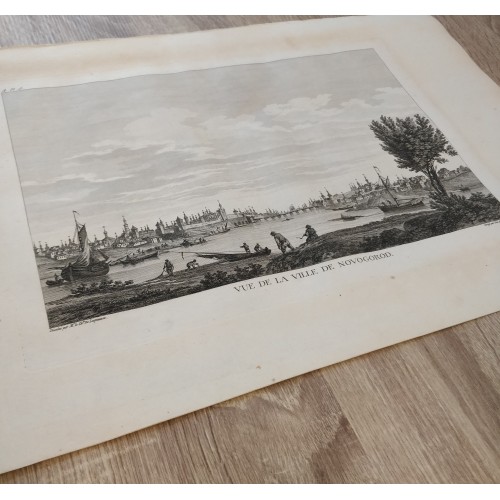
Vue de la Ville de Novogorod.
Description: Striking and highly detailed fine unusual large copper engraved view of Novgorod, Russia. The view shows the city with his buildings, churches, town walls and surrounding landscape. Several sailing ships and inhabitants adorn the view.
The view has been drawn by Louis-Nicolas de Lespinasse and engraved by Claude Niquet & Franзois Denis Neй.
Source: Nicolas-Gabriel Le Clerc. Histoire physique, morale, civile et politique de la Russie ancienne & moderne. Paris & Versailles: Froullй & Blaizot, 1783-1794.
References: Cohen/Ricci, 613; Brunet, III, 916; Lewine S., 302; Sander, 1138.
Date: 1784 ( undated )
Dimension: Paper size approx.: cm 49,2 x 32,6
Condition: Very strong and dark impression on good paper. Paper with chains and wiremarks. Sheet uncolored. Wide margins. Corners partially missing. Small foxing and browning. Conditions are as you can see in the images.
Artists & Writer: Louis-Nicolas de Lespinasse (1734 -1808), called the Chevalier de Lespinasse , has been a French Artist.
Claude Niquet, known as the eldest, was a French draftsman and engraver born around 1770 and died in 1831, marked by the neoclassical style.
Franзois Denis Nйe (1732 - 19 August 1817) was a French engraver. He was born and died in Paris. He trained under Jacques-Philippe Le Bas and opened a shop with Louis-Joseph Masquelier the Elder in the 1770s on rue des Francs-Bourgeois, moving to rue de Fleurus after the French Revolution, where they produced lithographs. He is most notable for his engravings of the works of Jean-Baptiste Lallemand as well as his participation in Les Conquкtes de l'Empereur de Chine, a major work commissioned by the Jesuits Jean-Denis Attiret, Giuseppe Castiglione, Ignaz Sichelbart and Jean Damascene. This was a series of 12 complementary engravings coordinated by Charles-Nicolas Cochin, with copperplates engraved in Paris between 1772 and 1774 at the expense of the Qianlong sovereign. He also worked for the views of the Temple of Diana in Nismes, under the french engraver Claude-Renй-Gabriel Poulleau. Together with other artists they marked the fame of Charles-Louis Clйrisseau and his Antiquitйs de la France. His pupils included Joseph C. Maillet (1751-1811), publisher and printseller.
Nicolas-Gabriel Clerc , known as Le Clerc, (1726-1798), is a French physician, historian, essayist and cartographer. He was a staunch Physiocrat 2 and a supporter of the Enlightenment. Coming from a family of doctors, Nicolas-Gabriel Clerc became a doctor himself; it is distinguished by innovations in practice. First assigned to the army of the Bas-Rhin, he was appointed first doctor of the king's armies in Germany in 1757; he seeks to reform the abuses which have been introduced into the administration of military hospitals. In 1759, at the request of Empress Elizabeth and with the approval of King Louis XV, he traveled to Russia, where this country was experiencing its own era of Enlightenment. General Kirill Razoumovski, hetman of the Cossacks, chose him as his doctor, took him with him on a journey through the main courts of Europe, offering him on his return ownership of the town of Baturin, on condition that he never leave, which Clerc refuses (he would have spent the rest of his life in Russia). He returned to France in 1762; he was appointed physician to the Duke of Orlйans. He returned to Russia in 1769, with the title of first physician to the Grand Duke and school director of the Imperial Corps of Cadets; he became inspector of the Paul hospital, founded in Moscow by the Grand Duke. During this second trip, and following the wishes of Louis XV, he gathered the materials for a history of Russia - a country of which we knew almost nothing, and returned to France in 1777, with many texts but also established maps. at its expense. In France, however, he is quickly forgotten, and the promises that had been made to him remain vain; he then decided to retire to Franche-Comtй, under the name of Leclerc. Then he was recalled to Versailles, in order, once again, to reform the abuses in the hospitals; he was appointed president of the commission responsible in 1778 for indicating adjustments, and received the title of inspector general of hospitals in the kingdom. His first memoir receives the approval of the ministry, but the reforms are postponed, and Leclerc is again forgotten. He ends his history of Russia when the Revolution arrives, which deprives him of his pensions from the Ministry of Foreign Affairs. Withdrawn to Versailles, he died there in 1798, at the age of 73; he was an honorary member of the Imperial Academy of Sciences of Saint Petersburg, of the academies of Besanзon and Rouen and, under the previous regime, knight of the order of the king.
Антикварная гравюра Великий Новгород Lespinasse 1784
По рисунку г. Ш. де Леспинасе. Гравировал Нике, под руководством Ф.-Д. Нее.
Гравюра из атласа к изданию А.Ф. Леклерка «Физическая, моральная, гражданская и политическая история современной России» (Париж, 1783-1784). (Nicolas-Gabriel Le Clerc. Histoire physique, morale, civile et politique de la Russie ancienne & moderne. Paris & Versailles: Froullй & Blaizot, 1783-1794.)
References: Cohen/Ricci, 613; Brunet, III, 916; Lewine S., 302; Sander, 1138.
Оригинальное название -Vue de la Ville de Novogorod.
Гравюра выполнена по оригиналу французского художника Луи Николя Леспинаса (1734-1808) известным мастером гравюры Франсуа-Дени Нее (1732-1817) для альбома к популярному в XVIII веке сочинению Леклерка. В атлас входило 38 сложенных гравюр, карт, планов.
Date: 1784 ( undated )
Представленные в атласе города Российской империи были наиболее известными для своего времени. В атлас включались виды городов Сибири, а также Петербурга, Твери, Новгорода, Казани, Кронштадта и планы Петербурга и Москвы.
Во второй половине XVIII века эти изображения были, безусловно, одними из первых и наиболее достоверных, поскольку отражали своеобразие пейзажа и этнографические особенности одежды местного населения, что соответствовало восприятию иностранцами России как экзотической страны. Атлас содержал 56 гравированных листов с панорамными видами Санкт-Петербурга, включая уникальный план Санкт-Петербурга, гравированный П. Ф. Тардье, план Москвы, виды городов Тобольска, Екатеринграда, Якутска и др. Гравюры, вошедшие в состав атласа, были выполнены выдающимися мастерами французской школы гравировального искусства - одной из самых интересных и сильных в XVIII в. Во второй половине XVIII в. эти изображения городов России стали одними из первых и наиболее достоверных.
В хорошем состоянии - см фото.
Бумага верже с водяными знаками.
Размер листа cm 49,2 x 32,6, размер изображения 36 x 28 cm - Обратная сторона чистая