
List on Ebay
List on Ebay
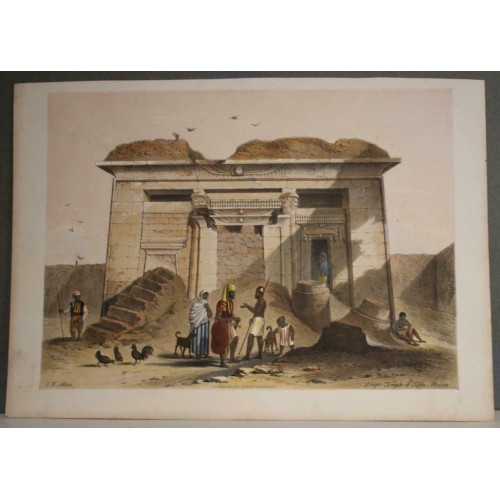
Антикварная литография "Панорамный вид на Храм Калабша" 1843 год из издания John Harrison Allan. A Pictorial Tour in the Mediterranean: Including Malta, Dalmatia, Turkey, Asia, Minor, Grecian, Archipelago-Egypt-Nubia-Greece-Ionian Islands-Sicily-Italy-and Spain" изданого в Лондоне в издательстве Longman, Brown, Green, and Longmans в1843.
Оригинальное название написано в правом нижнем углу:"Larger Temple of Jeffa, Nubia"
Храм Калабша - древний египетский храм, который был первоначально расположен в Баб эль-Калабша приблизительно в 50 километрах к югу от Асуана. Храм Калабша находился на западном берегу реки Нил в Нубии и был первоначально построен приблизительно в 30 до н. э во время раннего периода римского владычества над Египтом.
Дата: 1843 ( недатированная )
Размер листа 33,6 x 23,9 см
Бумага плотная в отличном состоянии
Original antique colored litographic panoramic view of the Temple of Kalabasha 1843
TEMPLE OF KALABSHA EGYPT 1843 ALLAN ANTIQUE ORIGINAL COLORED LITHOGRAPHIC VIEW
ANTIQUE ORIGINAL LITHOGRAPHIC VIEW TEMPLE OF KALABSHA
Description
Larger Temple of Jeffa, Nubia.
Description: Striking and highly decorative unusual original colored litographic panoramic view of the Temple of Kalabasha, in Lower Nubia, Egypt. Several inhabitants complete the view.
The Temple of Kalabsha (also Temple of Mandulis) is an ancient Egyptian temple that was originally located at Bab al-Kalabsha (Gate of Kalabsha), approximately 50 km south of Aswan. The temple was inscribed on the UNESCO World Heritage List in 1979, along with other outstanding examples of Nubian architecture including Abu Simbel and Amada.
The temple was situated on the west bank of the Nile River, in Nubia, and was originally built around 30 BC during the early Roman era. While the temple was constructed in Augustus's reign, it was never finished. The temple was a tribute to Mandulis (Merul), a Lower Nubian sun god. It was constructed over an earlier sanctuary of Amenhotep II.
The temple is 76 m long and 22 m wide in dimension. While the structure dates to the Roman period, it features many fine reliefs such as "a fine carving of Horus emerging from reeds on the inner curtain wall" of the temple. From Kalabsha's "sanctuary chambers, a staircase leads up to the roof of the temple" where one can see a splendid view of the temple itself and the sacred lake.
Several historical records were inscribed on the temple walls of Kalabsha such as "a long inscription carved by the Roman Governor Aurelius Besarion in AD 250, forbidding pigs in the temple" as well as an inscription of "the Nubian king Silko, carved during the 5th century and recording his victory over the Blemmyes and a picture of him dressed as a Roman soldier on horseback." Silko was the Christian king of the Nubian kingdom of Nobatia.
When Christianity was introduced to Egypt, the temple was used as a church.
Source: John Harrison Allan. A Pictorial Tour in the Mediterranean: Including Malta-Dalmatia-Turkey-Asia Minor-Grecian Archipelago-Egypt-Nubia-Greece-Ionian Islands-Sicily-Italy-and Spain, London, Longman, Brown, Green, and Longmans, 1843.
Date: 1843 ( undated )
Dimension: Paper size approx.: cm 33,6 x 23,9
Condition: Very strong and dark impression on good paper. Plate old original colored. Quite margins. Corners partially missing. Small and browning. foxing. Conditions are as you can see in the images.
Cartographers: John Harrison Allan (1820-1882) was from Britain. He was a member of the Athenian Archaeological Society and the Egyptian Society of Cairo. He made a journey to the Mediterranean from April 1841 to June 1842. This Grand Tour of the East had become quite usual for wealthy European in the 19th century, and was considered almost a necessity, as a means to educate oneself and as a sign of social status.
Allan published his memoir in 1843, creating a work, of interest above all for its illustrations, which was republished two times. The plates illustrating this large-format work were based on drawings made by Allan himself. The edition is comprised by forty lithographs and sixty-eight wood engravings.
The voyage began in Liverpool. The ship reached Venice by way of Gibraltar and Malta, sailed across the Adriatic and the Жgean sea and reached Istanbul. In continuation, the company sailed along the coast of Asia Minor, stopped over at Syros and set anchor at Alexandria. They explored Egypt down to the cataracts of the Nile in Assouan and returned to Alexandria. After a stopover at Malta, they were in Syros again, from where they travelled to Athens. They toured Attica, the Peloponnese, Delphi, and reached Patras. They then visited the Ionian islands, and sailed to Malta, Sicily, Southern Italy, Rome, Marseilles, Barcelona, Malaga and Lisbon.
9759
- Product Code: 9759
- Availability: In Stock
-
$0.00
- Ex Tax: $0.00