
My note:8886
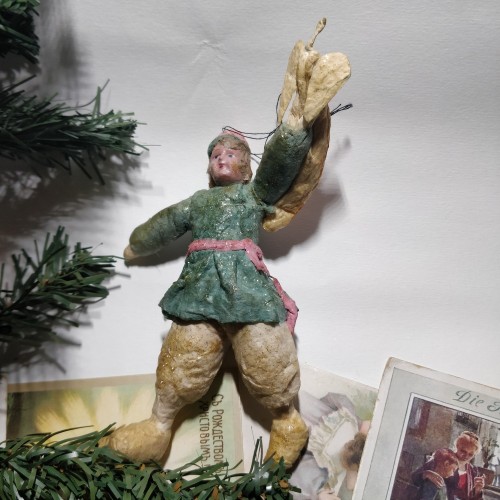
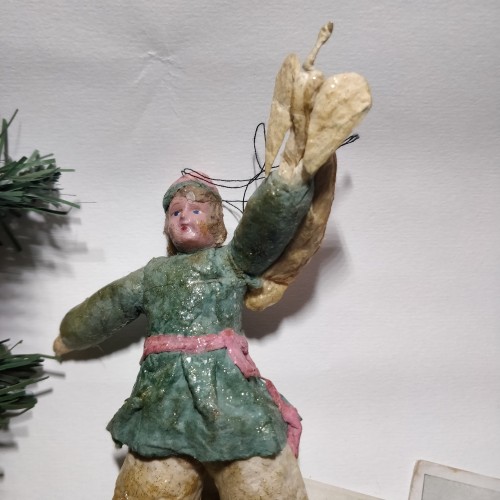
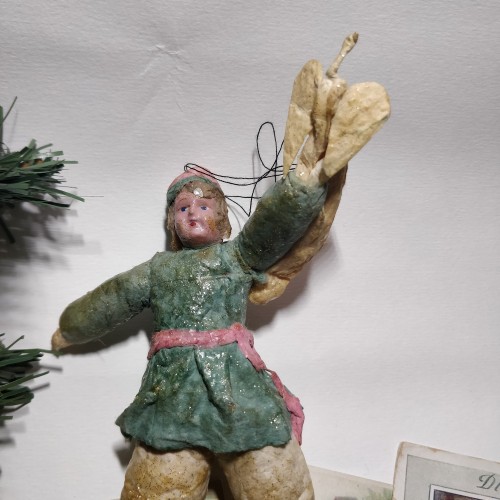
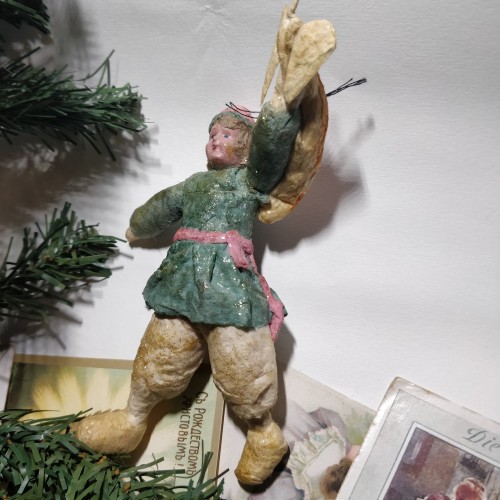
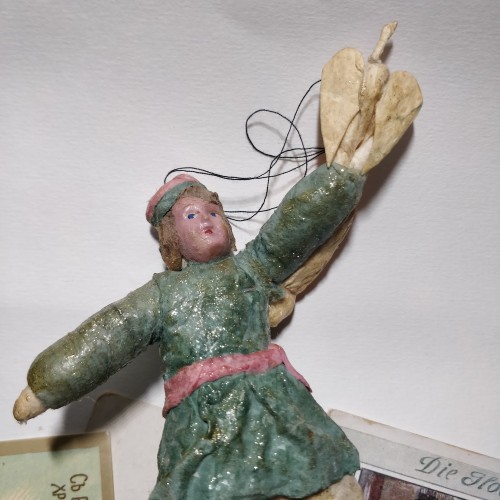
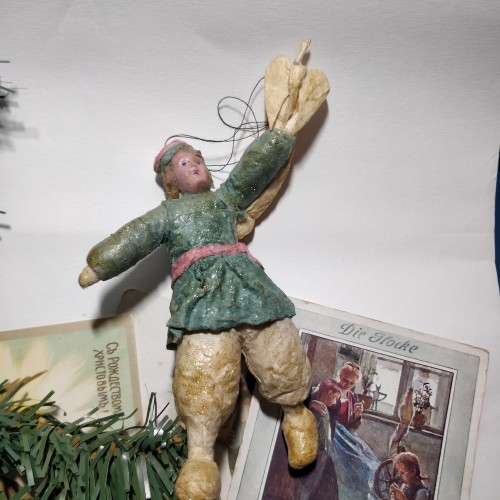
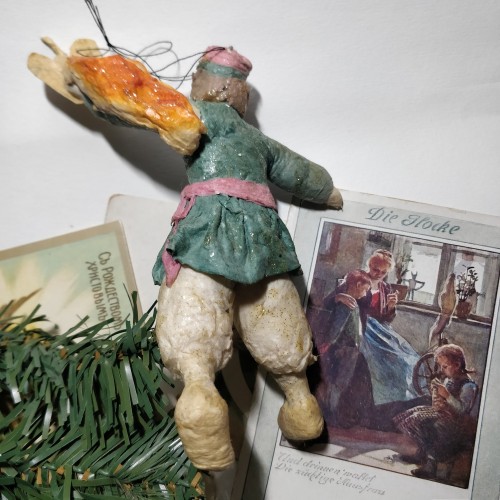
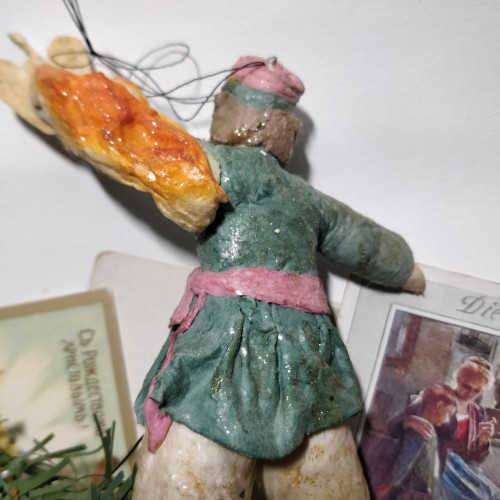
Ivan with Firebird Antique Russian Christmas Spun-Cotton Ornament 1950
15 см (6") tall. The face is made of paper-mache.
It's in good condition for its age. Please inspect the photos carefully.
Once upon a time there was a Tzar. He heard that there was a bird that lived in a beautiful garden and ate golden apples there. There was just one of these birds in the whole world. It was named Firebird because it looked with an intense glare. Nobody could touch it - its plumage would burn everyone. The Tzar ordered his servant, Ivan, to catch Firebird. Ivan took the fastest horse and to arrive at the garden. He climbed over the wall to enter the garden. Ivan saw the Firebird. Its wings were gold and its eyes resembled a diamond. He knew that nobody could touch it, but he had very course mittens. He caught Firebird in a cage.
Then he delivered Firebird to the Tzar who was happy that nobody else in the whole world had this amazing bird, except him. Only Ivan wasn't happy because he knew that he had opened Pandora's box for the Tzar. Like all good stories this fairy tale has a happy ending.
Spun cotton ornaments originated in Germany in the 19th century and were used to decorate goose-feather trees. They were made by artisans in the cottage industry. Today, antique spun cotton ornaments are highly collectible. Little information remains regarding how these ornaments were made, despite years of research. A figure that measures 2"-3" often takes several hours to complete. When you purchase from a Spun Cotton Ornament, you are receiving a piece of history.
The person more commonly credited with bedecking the first Christmas tree is Martin Luther (1483-1546). Supposedly, while he was walking outside one night, he was so inspired by the stars twinkling through the trees that he cut down a tree and decorated it with candles, to recreate the outdoor effect. No contemporary record of this event exists, so it may never have happened, but if it did, that makes candles the most traditional ornament of all.
In the mid 16th century, Christmas markets were set up in German towns, to provide everything from gifts, food and more practical things such as a knife grinder to sharpen the knife to carve the Christmas Goose! At these fairs, bakers made shaped gingerbreads and wax ornaments for people to buy as souvenirs of the fair, and take home to hang on their Christmas Trees.
The best record we have is that of a visitor to Strasbourg in 1601. He records a tree decorated with "wafers and golden sugar-twists (Barleysugar) and paper flowers of all colours". The early trees were biblically symbolic of the Paradise Tree in the Garden of Eden. The many food items were symbols of Plenty, the flowers, originally only red (for Knowledge) and White (for Innocence).
Two more ornaments can be traced to the Middle Ages as well. Medieval mystery plays, designed to entertain the masses while teaching them Christian doctrine, often featured "paradise trees" decorated with apples. Apples and other fruits made their way onto Christmas trees quite early, first in natural forms and later made from marzipan, glass, and other materials. Mystery play trees also featured unconsecrated Communion wafers, representing the antidote to the forbidden fruit. Wafers appeared on early Christmas trees, too.
Fruit has always been associated with Christmas. In Europe fruits and nuts and gingerbreads were popular gifts, and small locally grown apples and hard pears and nuts were often placed on Christmas trees throughout Europe and Britain. But only locally grown and plentiful fruits, which were later eaten from the branches as part of the Christmas feasting. If candles, apples, and wafers don't seem quite festive enough, it's also historically accurate to add paper roses and shiny foil shapes.
Pictures are part of the description and reflect the current state of the article. The real color of the item may be slightly different from the pictures shown on the website caused by many factors such as brightness of your monitor and light brightness.
Shipping: Standard domestic and international shipping. We are more than happy to combine purchases. Please note that any returns, insurances or customs duties levied are the responsibility of the buyer. Customs can cause delays with your shipment which the seller has no control over. Please consider such delays when making your purchase.
Despatch Time: We ship via registered airmail with the tracking number within 72 hours of receipt of cleared payment. The estimate delivery time to Europe is about 20-30 days, to the USA 30-60 days
Returns: If you are not happy with your item, please return it to us in its original packaging within 14 days. Return shipping must be paid for by the buyer. Refund of purchase price will be made through Paypal.
girl Muff (handwarmer) Antique Christmas Spun-Cotton Ornament Made in USSR 1940
- Product Code: 8886
- Availability: In Stock
-
$150.00
- Ex Tax: $150.00