
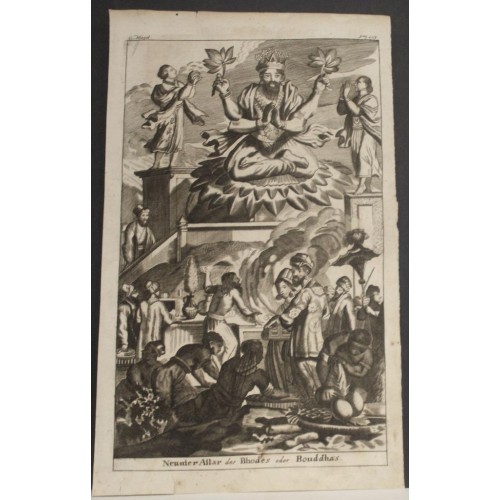
INDIA TEMPLE OF BUDDHA 1681 DAPPER UNUSUAL ANTIQUE COPPER ENGRAVED PLATE
ANTIQUE COPPER ENGRAVED PLATE OF TEMPLE OF BUDDHA INDIA
old times rare books and maps
old times rare books and maps
(19538)
100% positiveSeller's other itemsSeller's other itemsContact seller
US $33.00
INDIA TEMPLE OF BUDDHA 1681 DAPPER UNUSUAL ANTIQUE COPPER ENGRAVED PLATE
Description
Neunter Altar des Bhodes oder Buddhas.
Description: Striking and highly detailed copper engraved view of aTemple of Buddha, India, at the time of the Mughal Empire. Several Natives adorn the view.
The Mughal Empire was an early modern empire based in South Asia between the 16th and 19th centuries. For some two hundred years, the empire stretched from the outer fringes of the Indus River Basin in the west, northern Afghanistan in the northwest, and Kashmir in the north, to the highlands of present-day Assam and Bangladesh in the east, and the uplands of the Deccan Plateau in South India.
The Mughal Empire is conventionally said to have been founded in 1526 by Babur, a chieftain from what is today Uzbekistan, who employed aid from the neighboring Safavid and Ottoman Empires, to defeat the Sultan of Delhi, Ibrahim Lodi, in the First Battle of Panipat, and to sweep down the plains of North India. The Mughal imperial structure, however, is sometimes dated to 1600, to the rule of Babur's grandson, Akbar. This imperial structure lasted until 1720, until shortly after the death of the last major emperor, Aurangzeb, during whose reign the empire also achieved its maximum geographical extent. Reduced subsequently to the region in and around Old Delhi by 1760, the empire was formally dissolved by the British Raj after the Indian Rebellion of 1857.
Although the Mughal Empire was created and sustained by military warfare, it did not vigorously suppress the cultures and peoples it came to rule; rather it equalized and placated them through new administrative practices, and diverse ruling elites, leading to more efficient, centralised, and standardized rule. The base of the empire's collective wealth was agricultural taxes, instituted by the third Mughal emperor, Akbar. These taxes, which amounted to well over half the output of a peasant cultivator, were paid in the well-regulated silver currency, and caused peasants and artisans to enter larger markets.
The relative peace maintained by the empire during much of the 17th century was a factor in India's economic expansion. The burgeoning European presence in the Indian Ocean and an increasing demand for Indian raw and finished products generated much wealth for the Mughal court. There was more conspicuous consumption among the Mughal elite, resulting in greater patronage of painting, literary forms, textiles, and architecture, especially during the reign of Shah Jahan. Among the Mughal UNESCO World Heritage Sites in South Asia are: Agra Fort, Fatehpur Sikri, Red Fort, Humayun's Tomb, Lahore Fort, Shalamar Gardens, and the Taj Mahal, which is described as "the jewel of Muslim art in India, and one of the universally admired masterpieces of the world's heritage."
Source: Olfert Dapper. Umbstдndliche und eigentliche Beschreibung von Asia: in sich haltend die Landschafften Mesopotamien, Babylonien, Assyrien, Anatolien oder Klein-Asien ... ins Hochteutsche getreulichst ьbers. Von J. Ch. Beern. Nьrnberg, Ch. S. Froberg fьr J. Hoffmann, 1681.
Date: 1681 ( undated )
Dimension: Paper size approx.: cm 20,1 x 32,6
Condition: Very strong and dark impression on good paper. Sheet with chains. Sheet old original colored. Wide margins. Corners partially missing. Small foxing and browning. Small tears. Conditions are as you can see in the images.
Mapmaker: Olfert Dapper (1636 - December 29, 1689) was a Dutch geographer, polyglot, and historian. Born in Amsterdam, he attended the University of Utrecht, where he was registered as a student in 1658. Two years later he began signing doctor medicinж, but there in no evidence that he ever received any medical training or education. Dapper published a five-volume book about the history of Amsterdam entitled, Historische Beschrijving der Stadt Amsterdam and in 1665 published a Dutch translation from the Greek of the Histories of Herodotus. His best-known work, Naukeurige Beschrijvingen der Afrikaensche gewesten (Description of Africa), was published in 1668 and subsequently published in English by John Ogilby in 1670 and in French in 1686. Although Dapper never traveled to Africa, he took advantage of numerous reports from adventurers in order to compile this authoritative work over the course of three years.
8771
- Product Code: 8771
- Availability: In Stock
-
$0.00
- Ex Tax: $0.00