
DOUAI FRANCE 1745 ISAAC BASIRE ANTIQUE ORIGINAL COPPER ENGRAVED CITY MAP
ANTIQUE COPPER ENGRAVED CITY MAP OF DOUAI FRANCE 1745
DOUAI FRANCE 1745 ISAAC BASIRE ANTIQUE ORIGINAL COPPER ENGRAVED CITY MAP
Description
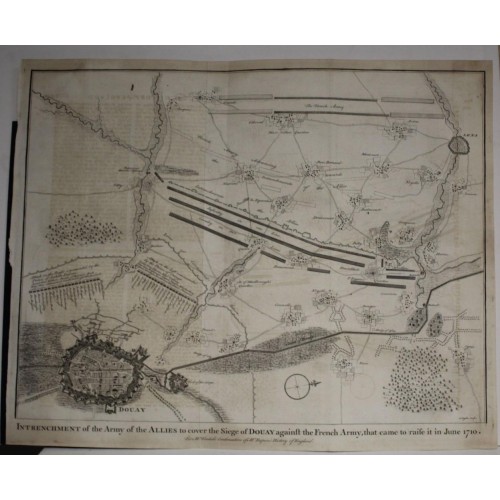
intrenchement of the Army of the Allies to cover the Siege of Doway against the French Army, that came to raise it in July 1710. For Mr. Tindal's Continuation of Mr. Rapin's History of England.
Description: Striking and highly detailed interesting 1745 Isaac Basire's copper engraved map featuring a plan of the French fortified city of Douai with his buildings, streets, churhes & town walls, at the time of the siege of the city, during the Spanish War of Succession.
The map is highly detailed, showing cities, topography and troop locations. A simple title at the lower central side and a compass rose complete the sheet.
The plate has been published “Mr. Tindal's Continuation of Mr. Rapin's History of England”, printed ca. 1735-45, London.
Date: 1745 ( undated )
Dimension: Paper size approx.: cm 49,4 x 39,6
Condition: Very strong and dark impression on good paper. Paper with chains and wiremarks. Map uncolored. Small margin to the top. Short lower margin. Small right lateral margin. Small left lateral margin. Corners partially missing. Small foxing and browning. Plate folded. Conditions are as you can see in the images.
Mapmakers: Isaac Basire (20 September 1704 – 24 August 1768) was an engraver and first in a family line of prolific and well-respected engravers. Isaac Basire was known as a map engraver. His most well-known work is the frontispiece to an edition of Bailey's dictionary (1755).
He was born in London the son of Jacques or James Basire, a Huguenot and native of Rouen, and Magdelaine Lair. Isaac sparked a prodigious line of engravers, including his son James (1730-1802), grandson James (1769-1822), and great-grandson James (1796-1869). There is some difficulty in assigning works to a particular member of the family. All four worked as engravers, sometimes as an apprentice to his father, with overlapping periods of productivity, and three shared the same name.
James Basire
James Basire (1730–1802), also known as James Basire Sr., was the most significant of the family of engravers. He was noted for his skill at architectural prints and his apprenticing of the young William Blake.
James Basire II
James Basire the second (12 November 1769 – 13 May 1822) succeeded his father in an appointment from the Society of Antiquaries, indicating that he was a good draughtsman, a capable and accomplished engraver. His work and methods were nearly indistinguishable from his father's. Much of his best work was published by the Society of Antiquaries in 1808.
James Basire III
The last known James Basire was born in 1796 and died in London on 17 May 1869. He did a number of plates of Sussex country-houses including Glynde Place and Glyndebourne House, but his work and artistic skill were not as well-regarded.
Paul de Rapin (25 March 1661 – 25 April 1725), sieur of Thoyras (and therefore styled Thoyras de Rapin), was a French historian writing under English patronage. His History of England, written and first published in French in 1724–27, was an influential exposition of the Whig view of history on both sides of the English Channel.
The son of Jacques de Rapin, an avocat at Castres (Tarn), he was educated at the Protestant Academy of Saumur, and in 1679 became an advocate, but soon afterwards joined the army. The revocation of the Edict of Nantes in 1685, and the death of his father led him to move to England; but, unable to find work there, he went on to the Netherlands where he enlisted in a company of French volunteers at Utrecht, commanded by his cousin, Daniel de Rapin.
He accompanied William III to England in 1688, and during the Williamite war in Ireland he took part in the Siege of Carrickfergus and the Battle of the Boyne, and was wounded at the Siege of Limerick (1690). Soon afterwards he was promoted to captain; but in 1693 he resigned in order to become tutor to the Earl of Portland's son. After travelling with the boy, he settled with his family (he married Marie-Anne Testart in 1699) in Holland, first at the Hague, then, to save money, at Wesel, in 1707.
Nicolas Tindal (1687 – 27 June 1774) was the translator and continuer of the History of England by Paul de Rapin. Very few comprehensive histories existed at the time and Tindal wrote a three-volume 'Continuation', a history of the Kingdom from the reigns of James II to George II. Tindal was Rector of Alverstoke in Hampshire, Vicar of Great Waltham, Essex, Chaplain of Greenwich Hospital and a Fellow of Trinity College, Oxford.
10283
- Product Code: 10283
- Availability: In Stock
-
$0.00
- Ex Tax: $0.00