
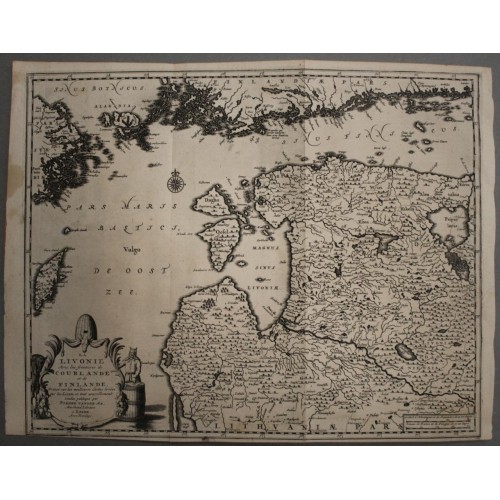
Latvia & Finland 1727 Olearius & Van Der Aa Antique Map
antique Copper Engraved Map Of Latvia & Finland 1727
Description
La Livonie Avec les frontieres de Courlande et de Finlande, Dressй sur les meuilleures Cartes levйes sur les Lieux, et tout nouvellement rendue publique par Pierre vander Aa, Marchand Libraire a Leide. Avec Privilege.
Description: Striking and highly decorative unusual 1727 copper engraved map of the Latvia. Covers also sputhern part of Finland, a bit of Sweden and part of Lithuania. The map is filled with excellant topographic details on cities, towns, rivers, lakes, forests, fjords and islands. A decorative title cartouche, a block-style mileage scales cartouche & a compass rose complete the map.
Source: Adam Olearius: Voyages trиs-curieux et trиs-renommez faits en Moscovie, Tartarie et Perse: dans lequels on trouve une description curieuse & la situation exacte des pays & etats, par oщ il a passй [..]. Bd.1. A Amsterdam: chez Michel Charles le Cйne, 1727.
Date: 1727 ( undated )
Dimension: Paper size approx.: cm 38,8 x 29,9
Condition: Very strong and dark impression on good paper. Paper with chains and wiremarks. Map uncolored. Small margin to the top. Lower margin cut very shortly. Quite right lateral margin. Good left lateral margin. Corners partially missing. Small foxing and browning. Sheet folded. Conditions are as you can see in the images.
Author: Adam Olearius (born Adam Цlschlдger or Oehlschlaeger, 24 September 1599 – 22 February 1671) was a German scholar, mathematician, geographer and librarian. He became secretary to the ambassador sent by Frederick III, Duke of Holstein-Gottorp, to the Shah of Safavid Persia (Iran), and published two books about the events and observations during his travels. He was born at Aschersleben, near Magdeburg. After studying at Leipzig he became librarian and court mathematician to Frederick III, and in 1633 he was appointed secretary to the ambassadors Philipp Crusius, jurisconsult, and Otto Bruggemann, a merchant from Hamburg, sent by the duke to Muscovy and Persia in the hope of making arrangements by which his newly founded city of Friedrichstadt should become the terminus of an overland silk-trade. This embassy started from Gottorp on 22 October 1633 and travelled by Hamburg, Lьbeck, Riga, Dorpat (five months' stay), Reval, Narva, Ladoga, and Novgorod to Moscow (14 August 1634). Here they concluded an advantageous treaty with Tsar Michael of Russia, and returned forthwith to Gottorp (14 December 1634 – 7 April 1635) to procure the ratification of this arrangement from the duke, before proceeding to Persia. With this accomplished, they started afresh from Hamburg on 22 October 1635, arrived at Moscow on 29 March 1636; and left Moscow on 30 June for Balakhna near Nizhniy Novgorod, to where they had already sent agents (in 1634/1635) to prepare a vessel for their descent of the Volga. Their voyage down the great river and over the Caspian Sea was slow and hindered by accidents, especially by grounding, as near Darband on 14 November 1636; but at last, by way of Shamakhy (three months' delay here), Ardabil, Soltaniyeh and Kasvin, they reached the Persian court at Isfahan (3 August 1637) and were received by the Safavid king, Shah Safi (16 August). Negotiations here were not as successful as at Moscow, and the embassy left Isfahan on 21 December 1637, and returned home by Rasht, Lenkoran, Astrakhan, Kazan, Moscow, and other places. At Reval, Olearius parted from his colleagues (15 April 1639) and embarked directly for Lьbeck. On his way he had made a chart of the Volga, and partly for this reason Michael wished to either persuade or compel him to enter his service. Once back at Gottorp, Olearius became librarian to the duke, who also made him keeper of his cabinet of curiosities, and induced the tsar to excuse his (promised) return to Moscow. Under his care the Gottorp library and cabinet were greatly enriched in manuscripts, books, and oriental and other works of art: in 1651 he purchased, for this purpose, the collection of the Dutch scholar and physician, Bernardus Paludanus (born Berent ten Broecke). He died at Gottorp on 22 February 1671.
Cartographer: Pieter van der Aa (1659 - 1733) was a Dutch publisher of maps and atlases active in the late 17th and early 18th centuries. Van der Aa was born in Leyden in 1659. At nine he was apprenticed to a local bookseller and, by 21, had established his own publishing, printing, and auctioneering house. In 1692 Van der Aa was appointed to be one of the High Commissioners of the Booksellers Guild. During his long and impressive career Van der Aa produced thousands of maps, including a vast 28 volume atlas containing no less than 3,000 maps. Few of Van der Aa's maps were original productions, most being copied from the work of earlier cartographers. Nonetheless, when one of Van der Aa's rare original pieces does appear, his style, with unusual projections, elegant engraving, and precise detail, is instantly recognizable and highly desirable. He also pioneered the cartographic idea of separating border artwork from the map plate itself such that every map in a collection could have a similar elaborate border without actually having to re-engrave the complex plates. This technique was used to great effect by later 18th century publishers like Brion de la Tour. Following Van der Aa's death in 1733, his much admired Nouvel Atlas was reissued by the Dutch firm of Covens & Mortier. Today Van der Aa's work is admired for its fine delicate engraving and unusual projections and is considered highly desirable among collectors.
7500
- Product Code: 7500
- Availability: In Stock
-
$0.00
- Ex Tax: $0.00