
Storage 22-09-2024
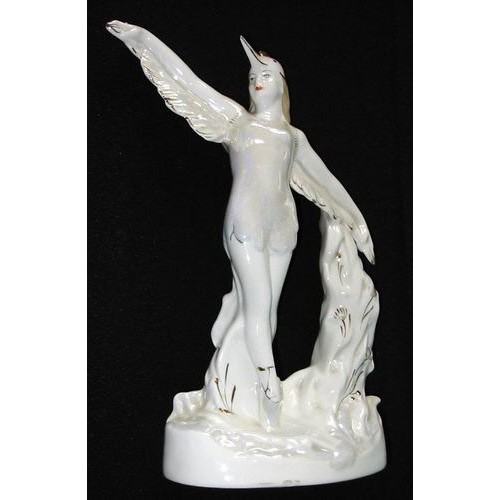
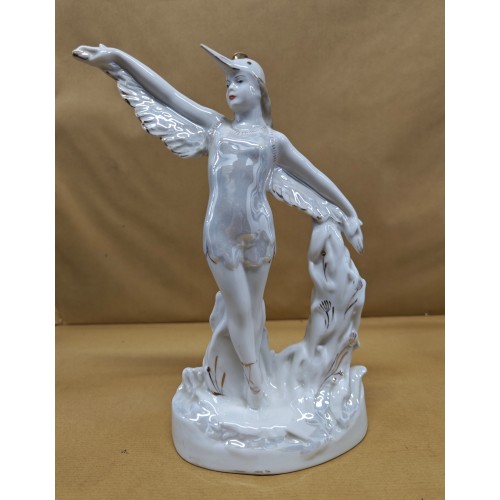
Ballerina-Swan Gardner Verbilky Antique porcelain figurine, Made in USSR, 1960s
Wonderful figurine was made at the Verbilky (former Gardner)Porcelain Factory in Verbilky. Gardner Porcelain Works was founded in Verbiki, outside Moscow, by the English-born Francis Gardner in 1766. The Gardner family retained ownership of the factory until 1891 and produced porcelain tablewares, figurines, and faience. The Gardner's porcelain works were one of the significant ones in Russia and yielded only to imperial ones,that were established in the 18th century by Vinogradov.
9 1/2 inch. tall. It is in excellent condition for its age.
It has a factory monogram on the bottom.
✨
Francis Gardner, an English timber merchant, settled in Russia in 1746 and, after twenty years in the timber trade, founded, on March 7, 1766, Russia's first privately-owned porcelain factory near the village of Verbilki, the Dmitrov uezd, Moscow gubernia.
Archives and surviving porcelain samples give a full case-history of the earliest Russian porcelain undertaking.
One other initiator of porcelain production in Russia, a marvel for the period, was Afanassy Grebenschikov, himself a porcelain factory owner from Moscow and a connoisseur in porcelain know-how, who helped Gardner choose a vantage site on which to build a factory: indeed, the timber wealths of the Verbilki area provided, for the long years ahead, the fuel in commercial quantities, while a variety of clays near Dmitrov, and of potteries, a traditional handicraft, in the town itself supplied raw materials and skilled master-potters.
When the factory began production, its earlier items were patterned after the Meissen porcelain, common in Russia in the eighteenth century and bore crossed swords, the Meissen trademark. However, the Verbilki masters often broke faith with the foreign styles in porcelain and tinted this manufacture with specifically Russian taste and artistic tradition, thus giving it a peculiarly national colour.
The fulfillment by the factory in 1780—1785 of the orders of the tsar's court for large dinner-sets, signified the full mastery of the techniques of porcelain production, which brought it fame and recognition among the collectors and lovers of porcelain pottery. So much so, that the trademark "G", the initial letter of the name "Gardner", boldly made an appearance on the porcelain pieces produced in the village of Verbilki.
In the early nineteenth century, the Gardner factory was shifted to the production of sculptures in the national Russian style, for which it gained a wide renown and which continued into the late nineteenth century. Artistically superb, the nineteenth-century Verbilki porcelain counts among the pick of decorative applied arts. The take-over of the factory in 1892 by Matvei Kuznetsov, a monopoly porcelain manufacturer in Russia, was another milestone since Kuznetsov, although he continued with Gardner's trademark, was keen on mass-producing cheap porcelain to conquer the home and foreign porcelain markets and compete successfully with his tenacious rivals. Under Kuznetsov the Verbilki produce gained in the technical standard but lost its artistic qualities, with decor confined, in the main, to mechanic painting techniques. When, after the 1917 October Revolution, the factory was nationalized,and given the name of the Dmitrov Porcelain Plant, it kept for a while in the mainstream of the pre-revolutionary forms and its decor was constricted to floral motifs.
Tea- and coffee-sets make the plant's speciality, along with a variety of fresh forms, well-suited to our age. New decor of porcelain pottery is executed by Soviet artists in the best Russian national traditions.
The Dmitrov porcelain is displayed at many home and foreign exhibitions where it is invariably highly appreciated and the artists conferred prizes and diplomas.
✨
? Pictures are part of the description and reflect the current state of the article. The real color of the item may be slightly different from the pictures shown on the website caused by many factors such as brightness of your monitor and light brightness.
? Shipping: Standard domestic and international shipping. We ship via registered airmail with the tracking number
? Please keep in mind that shipping takes 3–5 weeks to the USA and 10–20 days to Europe.
? Please note that any returns, insurances or customs duties levied are the responsibility of the buyer. Customs can cause delays with your shipment, which the seller has no control over. Please consider such delays when making your purchase.
? Returns: If you are not happy with your item, please return it to us in its original packaging within 14 days.
590
USSR 1960s Ballerina-Swan Porcelain Figurine
- Product Code: 590
- Availability: In Stock
-
$0.00
- Ex Tax: $0.00