
LIST ON EBAY
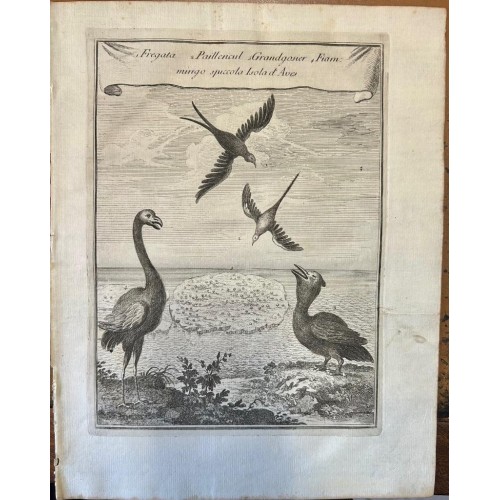
BIRDS OF CARRIBEAN ISLANDS 1763 COLTELLINI ANTIQUE ORIGINAL ZOOLOGICAL PLATE
ANTIQUE ZOOLOGICAL PLATE OF BIRDS OF CARIBBEAN ISLANDS
Condition:
--not specified
Ended:
Nov 28, 2023 21:03:36 PST
Winning bid:
US $9.99
BIRDS OF CARRIBEAN ISLANDS 1763 COLTELLINI ANTIQUE ORIGINAL ZOOLOGICAL PLATE
Description
1. Fregata 2. Paill'encul 3. Grandgosier 4. Fiammingo 5. piccola isola d'Aves.
Description: Striking and highly detailed fine unusual original copper engraved zoological plate showing a birds of Carribean islands.A Frigatebird: (perhaps) Fregata magnificen; paille-en-queue or white-tailed tropicbird: Phaeton lepturrus; pelican: (perhaps) Pelecanus occidentalis, and flamingo: Phoenicopteridae ruber ruber (or the Caribbean flamingo)..A banner-style title cartouche complete the plate.
Source: Il Gazzettiere americano contenente un distinto ragguaglio di tutte le parti del nuovo mondo della loro situazione, clima, terreno, prodotti, stato antico e moderno, merci, manifatture, e commercio. Con una esatta descrizione delle citta, piazze, porti baie, fiumi, laghi, montagne, passi, e fortificazioni. Il tutto destinato ad esporre lo stato presente delle cose in quella parte di globo, e le mire, e interessi delle diverse Potenze, che hanno degli stabilimenti in America. Tradotto dall'inglese e arricchito di aggiunte, note carte, e rami. Volume primo [-terzo]. Livorno, per Marco Coltellini all'insegna della veritа, 1763.
Date: 1763 ( undated )
Dimension: Paper size approx.: cm 24,6 x 31,2
Condition: Very strong and dark impression on good paper. Paper with chains. Map uncolored. Wide margins. Small foxing and browning. Conditions are as you can see in the images.
Publisher: Marco Coltellini was born in Livorno on 13 October. 1719 (as shown in a birth certificate cited by F. Pera, Appendix to memories and biographies of Livorno, Livorno 1877, p. 19) by Angiolo and Maria Maddalena Spigliantini. His father was "captain of the square in Prato" (Mazzei, I, p. 65), and his family had some literary tradition. Initially set on an ecclesiastical career, like his brother Carlo who would take orders and become a Capuchin, C. - who in the first booklets is designated with the title of abbot - then left religious life to get married. He had four daughters: Celeste, a renowned mezzo-soprano, Annetta, also a singer, Costantina and Rosina, both dedicated to painting.
Endowed with vast cultural interests, an attentive reader of the literary production of beyond the Alps (which soon earned him the reputation of being a non-conformist), he dedicated himself to poetry, composing mainly cantatas and melodramas from the end of the 1950s. Equipped with considerable financial means, in 1762 he purchased the most important printing press in Livorno, that of Giovan Paolo Fantechi at the "Insegna dellatruth", located in Via Grande (later Corso Vittorio Emanuele II), giving it new impetus also as a bookshop and stationery shop, of sale of the works of the Enlightenment.
Choosing Giuseppe Aubert as his assistant, who officially became director of the printing house in January 1764, C., often absent from Livorno, soon entrusted him with the management of the company. The activity of the printing press, which lasted until 1770, produced at least eighty works (this is the number of those that can certainly be attributed).
One of the first published editions, if not the first, was the translation of The American Gazetteer, containing a distinguished account of all parts of the New World (1763), which achieved excellent sales success. In that year Aubert and C. managed to obtain from V. Algarotti, who had retired to Pisa, permission to print first the Essay on the French Academy which is in Rome (1763), then the edition. complete of the Works (two editions: in five volumes in 1763-64 and in eight volumes in 1764-65, this one completed after the author's death). The publication of Algarotti's essay made C.'s printing house known to the Verri brothers and thus a fruitful collaboration began. In 1763 Pietro Verri commissioned Aubert to print his Meditations on happiness, which came out with the false London date, and the following year the Livorno printing house published, without indication of place, Dei delitti e delle pena by C. Beccaria.
Alongside its astute cultural action, the printing house was also able to distinguish itself for its technical qualities: correctness, clarity and aesthetic refinement. An excellent re-edition of Vasari's Lives (seven richly illustrated volumes) earned C. from Pietro Leopoldo the privilege of the title of Grand Ducal Printing House (1766). The disinterest shown by C. towards the studies of historical erudition, and antiquarian in particular, made relations with the Tuscan cultural world rather tense: in 1765 there was an open break with G. Lami, due to the continuous attacks directed by the Literary novels to books printed by the printing house.
C.'s continuous absences from Livorno ended up slowing down the printing activity: between 1768 and 1769 only three works were published. Finally, on 13 March 1770, the printing press, with the adjoining bookshop and stationery shop, was sold at auction for "2650 pieces of eight reals": the buyer, G. M. Fantechi, was probably a figurehead of Giovan Tommaso Masi, Coltellini's nephew.
The Livorno edition of the Encyclopйdie, carried out between 1770 and 1779, was therefore not published by C.: promoted by Aubert since 1767, with the establishment of a specific publishing company, to which the Grand Duke had granted large premises free and financial aid, was in fact published by Masi. However, C. was not totally uninvolved in the undertaking: on 18 November. In 1769 he wrote to the Sociйtй typographique of Neuchatel, sending the Prospectus of the edition and proposing the economic advantages of a distribution agreement. He later promised, but without following up with concrete results, to procure a certain number of associates in Vienna.
Alongside this sagacious and highly enlightened activity - for which C. also had to rely on the protection of the English consul John Dick to whom in '63 he dedicated one of his first and best-known works, the Iphigenia in Tauris -, he he cultivated a literary vocation which, after the first tests with cantatas and stage actions, turned towards the field of librettists in which he worked intensely starting from 1761, the year of his first melodrama, Almeria (Livorno), dedicated to Metastasio and set to music by F. De Maio. But the full affirmation came with that Iphigenia which Traetta had performed in '63 in Vienna (according to more recent studies even in '59) and which christened the happy meeting between C. and the the Apulian musician destined to renew himself equally positively, in Petersburg a decade later.
The success of the work earned him an invitation to the Austrian court, where in '64 C. took Metastasio's place as Caesarian poet; moreover, the path had already been prepared for him by his admirer and fellow citizen R. di Calzabigi, as well as by friends such as Gluck and G. Durazzo with whom, in March, he had gone to Paris. The Viennese period was quite industrious for C. who in about a decade wrote about ten librettos including some of the most famous, such as Telemaco for Gluck (1765), La Finta Simple for Mozart (1769) and Armida for Salieri ( 1771). But in '72 an imprudent satire in which Empress Maria Theresa thought she recognized herself destroyed his brilliant career at the Habsburg court. C., however, soon recovered from the hard blow: in that same year, in fact, he was offered to replace the Venetian Lodovico Lazzaroni in St. Petersburg who had retired in 1768. The St. Petersburg theater was one of the best in the international field at the time and his prestige required a careful selection of the elements of the Italian company, the backbone of the organisation. For this reason, in '68 Traetta was called and it was he, mindful of the perfect communion of intent achieved with C. in '63, who worked to renew the pairing; in fact, it is no coincidence that the composer, demanding when it comes to librettists, spent the four years between his arrival at court and that of C. in silence before setting to music, in 1972, Livorno's Antigona.
C.'s fame had now reached its peak not only in Russia, where the triumph of his Iphigenia, re-musiced there by Galuppi in '68 for Catherine II's birthday, had represented an excellent visiting card, but on an international level and it also proves the contemporary invitation of Frederick the Great which C. was forced to renounce due to the commitment already made in May with the empress. Soon, however, his biting spirit also made itself known at the St. Petersburg court, attacking the French sculptor Etienne Falconet who was setting up the gigantic bronze equestrian monument to Peter the Great (1766-1779); to make amends, C. then dedicated the Antigona to the Tsarina, receiving some extraordinary hundreds of rubles in addition to her already high fee. After this first libretto, the Livornese remained strangely inactive for Russian theaters, working on the writing of operas for foreign countries such as L'infedeltа delusa (Haydn, Esterhaz 1773), Il conte Baccellone (G. Rust, Venezia 1774), La Finta Giardiniera (P. Anfossi, Rome 1774). In 1777 he resumed writing for the court that hosted him, collaborating with Paisiello on Lucinda ed Armidoro, which was to be his last work.
C. in fact died in Petersburg in November 1777. According to Bonaventure he was poisoned by Catherine II against whom he once again launched his satirical attacks, but this supposition is drastically denied by Mooser.
C. began his activity as a librettist in the wake of Metastasio even if he never achieved either his originality or his delicacy; this does not mean that his own predecessor at the Viennese court had declared himself an admirer of it, as can be seen above all from the laudatory opinion he expressed on C.'s first work, the Almeria: "The whole style of the book is alive, harmonious, full of images and thoughts - we read in one of his letters dated 25 May 1761 (Tutte le opere, IV, p. 205) - there are airs that I would envy you and only to inexperience he attributes "overly crowded events" Already from his second important libretto, Iphigenia, Calzabigi's influence becomes preponderant and his imprint is decisive in Antigona, where C. manages to achieve the classic simplicity and unity of the drama, the goal of new poetics, while sacrificing the original catastrophe to the taste of the time. With this work he fits fully into the climate of melodrama reform, making his own the assumptions of a more complete and effective expressive interpenetration between music and text; the same, rare and not substantial, modifications to the Sophoclean tragedy are nothing more than "theatre coups" - as C. himself defines them - "dramatic-musical glimpses" aimed at a better interpretative possibility, on the part of the musician, of the rich psychology of the drama. Moreover, also for C. the new melodrama had to arise from "weaving poetry, dance, music and decoration together in the action" as recalled by Arteaga (II, p. 175), who also considers these precepts such "extravagances" of a system valid for "clarity of style, variety in the arias, beauty in the recitatives" but not so much for the coldness and implausibility of the "dissolutions". Confirmation of Kiltini's dramatic conception can also be found in
n a letter from the same poet to Frederick II of Prussia (translated from French in the Florentine edition of Antigona of 1773 by Lodovico Coltellini), where we read among other things: "in a country where the language is not sufficiently understood , we must try to speak more to the eyes than to the ears, and to interest more with the spectacle and with theatrical coups, rather than with the flowers of eloquence". And the public, as the librettist himself recognised, was not stingy with acclaim shared also by the majority of the critics as well as the musicians themselves, if we must judge from their names among the greatest of the time, as well as those of the performers, including the two Gabriellis in the Petersburg editions of Antigona and Cupid and Psiche are worth mentioning - and by the various musical versions of many of his librettos. This was the fate, for example, of Armida which, set to music for the first time in '71 in Vienna by Salieri, of which it was the first serious opera, was revived in 1782 by Righini and again in 1786, with the title of Armida and Rinaldo by Sarti for the inauguration of the Hermitage theater in Petersburg. Even with Armida C. pursues the classicizing current of Calzabigi, but already in '65 with Gluck's Telemachus he had preferred a style halfway between old and new just as in Cupid and Psyche, written in '67 for Gassmann, he was able to recall the classic fable combining "the spectacle of the senses with interest and possible emotion in good style (Natali, II, p. 162).
Alongside the serious, predominant genre, C. did not disdain the comic one in which he was mainly inspired by Goldoni: from a libretto of the same name by the playwright he in fact drew The Countess for Gassmann (performed in Mдhrisch-Neustadt from 3 to 7 September 1770 for the celebration of the meeting of Frederick II of Prussia with the Emperor Joseph II) and Mozart's La Finta Simple, also a cheerful remake of Goldoni's libretto (music by S. Perillo, Venice, Teatro S. Moisи, 1764), in which the In 1968, C. carried out a skilful revision for the just twelve-year-old child prodigy from Salzburg, replacing some arias and successfully modifying the third act.
5322
- Product Code: 5322
- Availability: In Stock
-
$0.00
- Ex Tax: $0.00