
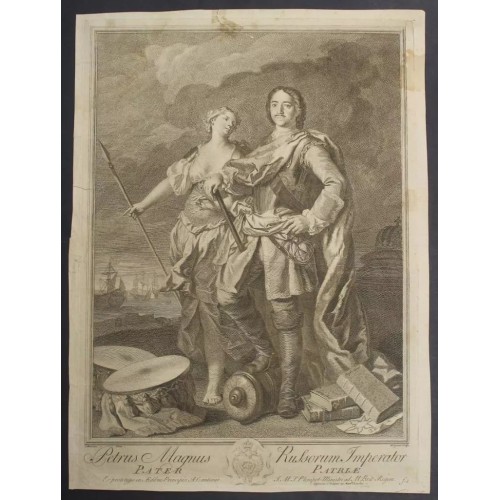
PETER THE GREAT RUSSIA 1730ca WAGNER UNUSUAL ANTIQUE COPPER ENGRAVED PORTRAIT
ANTIQUE COPPER ENGRAVED PORTRAIT OF PETER THE GREAT
old times rare books and maps
(20333)
100% positiveSeller's other itemsSeller's other itemsContact seller
US $207.50
Peter The Great Russia 1730ca Wagner Unusual Antique Copper Engraved Portrait
Description
Petrus Magnus Russorum Imperator Pater Patriж.
Description: Striking and highly detailed interesting unusual copper engraved portrait of Peter the Great, the Tzar of Russia.
Peter I (Russian: ???? I ??????????, romanized: Pyotr I Alekseyevich, 9 June [O.S. 30 May] 1672 – 8 February [O.S. 28 January] 1725), was Tsar of all Russia from 1682, and the first Emperor of all Russia, known as Peter the Great, from 1721 until his death in 1725. He reigned jointly with his half-brother Ivan V until 1696. From this year, Peter was an absolute monarch, an autocrat who remained the ultimate authority and organized a well-ordered police state.
Most of Peter's reign was consumed by long wars against the Ottoman and Swedish Empires. Despite initial difficulties, the wars were ultimately successful and led to expansion to the Sea of Azov and the Baltic Sea, thus laying the groundwork for the Imperial Russian Navy. His victory in the Great Northern War ended Sweden's era as a great power and its domination of the Baltic region while elevating Russia's standing to the extent it came to be acknowledged as an empire. Peter led a cultural revolution that replaced some of the traditionalist and medieval social and political systems with ones that were modern, scientific, Westernized, and based on radical Enlightenment.
In December 1699, he introduced the Julian calendar, which replaced the Byzantine calendar that was long used in Russia, but the Russian Orthodox Church was particularly resistant to this change. In 1703, he introduced the first Russian newspaper, Sankt-Peterburgskie Vedomosti, and ordered the civil script, a reform of Russian orthography largely designed by himself. On the shores of the Neva River, he founded Saint Petersburg, a city famously dubbed by Francesco Algarotti as the "window to the West". In 1714, Peter relocated the capital from Moscow, a status it retained until 1918.
Peter had a great interest in plants, animals and minerals, in malformed creatures or exceptions to the law of nature for his cabinet of curiosities. He encouraged research of deformities, all along trying to debunk the superstitious fear of monsters. He promoted industrialization in the Russian Empire and higher education. The Russian Academy of Sciences and the Saint Petersburg State University were founded in 1724, and invited Christian Wolff and Willem 's Gravesande.
Peter is primarily credited with the modernization of the country, quickly transforming it into a major European power. His administrative reforms, creating a Governing Senate in 1711, the Collegium in 1717 and the Table of Ranks in 1722 had a lasting impact on Russia, and many institutions of the Russian government trace their origins to his reign.
Date: 1730 ( undated )
Dimension: Paper size approx.: cm 38,9 x 52,8
Condition: Very strong and dark impression on good paper. Paper with chains and wiremarks. Sheet uncolored. Quite margins. Corners partially missing. Small foxing. Small marginal tears. Sheet partially reinforced on the verso. Sheet folded. Conditions are as you can see in the images.
Engraver & Artist: Joseph Wagner (1706 – 1780) was a highly regarded eighteenth century German engraver and draughtsman. He was born in Thalendorf in Gestratz, on Lake Constance, in 1706. He studied painting at Venice under Jacopo Amigoni, who persuaded him to turn to engraving, and Wagner accompanied Amigoni to Rome and Bologna, and in 1733 to England. He afterwards went to Paris, to study engraving under Laurent Cars. He then made a second stay in England, where his first productions were portraits of the three princesses, Anne, Amelia, and Caroline, the daughters of George ll. He engraved several other plates in England, but returned to Venice, where he opened a school and also carried on a considerable business as a print seller. He died in Munich in 1780. His prints are very numerous, and his students included Francesco Bartolozzi, Antonio Capellan, Fabio Berardi and Jean Jacques Flipart.
Jacopo Amigoni (c. 1685 – September 1752), also named Giacomo Amiconi, was an Italian painter of the late-Baroque or Rococo period, who began his career in Venice, but traveled and was prolific throughout Europe, where his sumptuous portraits were much in demand. He was born in Naples. Amigoni initially painted both mythological and religious scenes; but as the panoply of his patrons expanded northward, he began producing many parlour works depicting gods in sensuous languor or games. His style influenced Giuseppe Nogari. Among his pupils were Charles Joseph Flipart, Michelangelo Morlaiter, Pietro Antonio Novelli, Joseph Wagner, and Antonio Zucchi. Starting in 1717, he is documented as working in Bavaria in the Castle of Nymphenburg (1719); in the castle of Schleissheim (1725–1729); and in the Benedictine abbey of Ottobeuren. He returned to Venice in 1726. His Arraignment of Paris hangs in the Villa Pisani at Stra. From 1730 to 1739 he worked in England, in Pown House, Moor Park Wolterton Hall and in the theatre of Covent Garden. From there, he helped convince Canaletto to travel to England by telling him of the ample patronage available. In London or during a trip to Paris in 1736, he met the celebrated castrato Farinelli, whose portrait he painted twice in 1735 and again in 1752. Amigoni also encountered the painting of Franзois Lemoyne and Franзois Boucher. In 1739 he returned to Italy, perhaps to Naples and surely to Montecassino, in whose Abbey existed two canvases (destroyed during World War II). He travelled to Venice to paint for Sigismund Streit, for the Casa Savoia and other buildings of the city. In 1747 he left Italy for Madrid, encouraged by Farinelli, who held a court appointment there. He became court painter to Ferdinand VI of Spain and director of the Royal Academy of Saint Fernando. He painted a group portrait that included himself, Farinelli, Metastasio, Teresa Castellini, and an unidentified young man. The young man may have been the Austrian Archduke Joseph, the Habsburg heir to the throne. Amigoni died in Madrid. Amigoni was the father of the pastellist Caterina Amigoni Castellini, and the brother of the artist Carlotta Amigoni.
3661
- Product Code: 3661
- Availability: In Stock
-
$0.00
- Ex Tax: $0.00