
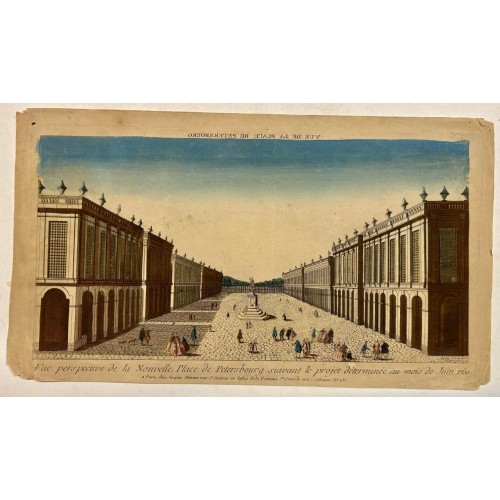
ST. PETERSBURG PALACE SQUARE RUSSIA 1760 CHEREAU ANTIQUE ORIGINAL OPTICAL VIEW
ANTIQUE COPPER ENGRAVED OPTICAL VIEW OF ST. PETERSBURG
old times rare books and maps
(20100)
100% positiveSeller's other itemsSeller's other itemsContact seller
US $66.00
ST. PETERSBURG PALACE SQUARE RUSSIA 1760 CHEREAU ANTIQUE ORIGINAL OPTICAL VIEW
Description
Elevation Perspective de la nouvelle Place de Petersbourg suivant le projet determinйe au mois de Juin 1760.
Description: Striking and highly detailed fine unusual 1760 Jacques Chereau's copper engraved so-called optical view of the Palace Square at Saint Petersburg, Russia. Several inhabitants adorn the view. Reverse title at the top central side.
Palace Square (Russian: ??????ґ??? ???ґ????, tr. Dvortsovaya Ploshchad), connecting Nevsky Prospekt with Palace Bridge leading to Vasilievsky Island, is the central city square of St Petersburg and of the former Russian Empire.
The earliest and most celebrated building on the square, the Baroque white-and-turquoise Winter Palace (as re-built between 1754 and 1762) of the Russian tsars, gives the square its name. Although the adjacent buildings are designed in the Neoclassical style, they perfectly match the palace in their scale, rhythm, and monumentality.[citation needed] The opposite, southern side of the square was designed in the shape of an arc by George von Velten in the late 18th century. These plans came to fruition half a century later, when Alexander I of Russia (reigned 1801–1825) envisaged the square as a vast monument to the 1812–1814 Russian victories over Napoleon and commissioned Carlo Rossi to design the bow-shaped Empire-style Building of the General Staff (1819–1829), which centers on a double triumphal arch crowned with a Roman quadriga.
In the centre of the square stands the Alexander Column (1830–1834), designed by Auguste de Montferrand. This red granite column (the tallest of its kind in the world) is 47.5 metres high and weighs some 500 tons. It is set so well that it requires no attachment to the base.
The eastern side of the square comprises Alexander Brullov's building of the Guards Corps Headquarters (1837–1843). The western side, however, opens towards Admiralty Square, thus making the Palace Square a vital part of the grand suite of St Petersburg squares.
The Vues d'optique were specifically developed to provide the illusion of depth when viewed through a zograscope, also known as an "optical diagonal machine" or viewers with similar functions.
Date: 1760 ( undated )
Dimension: Paper size approx.: cm 42 x 23,7
Condition: Very strong and dark impression on good paper. Paper with chains. Plate old original colored. Wide margins. Small foxing and browning. Corners partially missing. Small holes. Conditions are as you can see in the images.
Publisher: Jacques Chйreau (29 October 1688 in Blois, France – 1 December 1776 in Paris) was a portrait engraver, printmaker and publisher of optical prints in a neighborhood of printmakers at the Rue Saint-Jacques variously given on prints as "au Grand St. Remy," "au Coq," or "au dessus de la Fontaine St. Severin", in Paris, France. Jacques Chйreau was born the son of a carpenter Simon Chйreau & his wife Anne Hardouin, in Blois. Jacques ("le jeune Chйreau") worked for one year in England where vue optique prints were made, then worked with his older brother Franзois Chйreau (1680 Blois - 10 April 1729) who had studied with Pierre Drevet and Gйrard Audran. Franзois acquired Audran's plates in 1718 about the same time he was accepted to the academy. Jacques married Anne Antoinette Yvart (1688 – 28 September 1722), the daughter of painter Joseph Yvart on 9 February 1722 at St. Hippolyte.[1] After Anne died, Jacques married Marguerite-Geneviиve Chiquet (?- 11 May 1773), the daughter of engraver Jacques Chiquet (1673–1721) on 12 January 1724.[3] They had nine children. One of their daughters, Anne Louise, married Jacques (or James) Gabriel Huquier (1730–1805) on 30 November 1758 at Paris.[4] Huquier collaborated with Chйreau for three years, later printing and selling wallpapers and prints. In 1772, Huquier abandoned his family, moved permanently to England, leaving his three daughters in the care of the Chйreau family.[5] Jacques' son Jacques-Simon married Louise-Pierrette Charpentier[3] (?- 7 July 1796), engraver and daughter of engraver Etienne Charpentier in September 1760. Brother Franзois named one of his sons for uncle Jacques. Jacques Chйreau died of old age and fever at age 88 on 1 December 1776 at the home of his grandson, Jacques-Franзois Chйreau (1742–1794) who continued the printmaking business. Prints from this time are credited to "Jacques Chйreau" without distinction or to "Jacques-Franзois Chйreau." Jacques Chйreau was buried at the Church of St. Benedict (St. Benoit) on 2 December 1776.
12187
- Product Code: 12187
- Availability: In Stock
-
$0.00
- Ex Tax: $0.00