
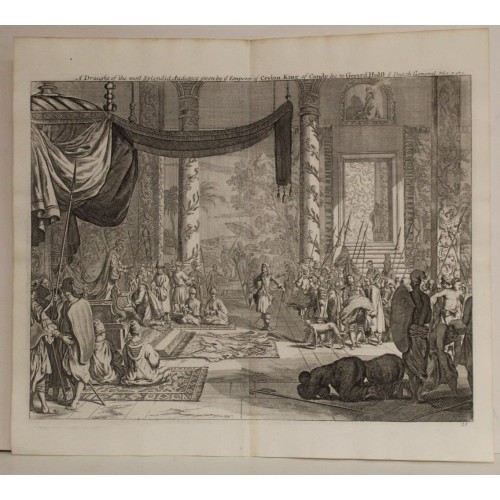
RAJASINHA II & GERARD HULST IMPERIAL AUDIENCE 1732 CHURCHILL UNUSUAL ANTIQUEVIEW
ANTIQUE COPPER ENGRAVED VIEW OF THE IMPERIAL AUDIENCE
old times rare books and maps
(20113)
100% positiveSeller's other itemsSeller's other itemsContact seller
US $29.00
RAJASINHA II & GERARD HULST IMPERIAL AUDIENCE 1732 CHURCHILL UNUSUAL ANTIQUEVIEW
Description
A draught of the most splendid audience given by ye Emperor of Ceylon, King of Candy to Gerard Hulst, ye Dutch General.
Description: Striking and highly detailed interesting 1732 copper engraved plate depicting the audience between the dutch conquerer Gerard Hulst and the majesty Raja Singa Rajou, Emperor of Ceylon.
During the reign of the Rajasinha II, Dutch explorers arrived on the island. In 1638, the king signed a treaty with the Dutch East India Company to get rid of the Portuguese who ruled most of the coastal areas. The following Dutch–Portuguese War resulted in a Dutch victory, with Colombo falling into Dutch hands by 1656. The Dutch remained in the areas they had captured, thereby violating the treaty they had signed in 1638. The Burgher people, a distinct ethnic group, emerged as a result of intermingling between the Dutch and native Sri Lankans in this period.
The Kingdom of Kandy was a monarchy on the island of Sri Lanka, located in the central and eastern portion of the island. It was founded in the late 15th century and endured until the early 19th century.
Initially a client kingdom of the Kingdom of Kotte, Kandy gradually established itself as an independent force during the tumultuous 16th and 17th centuries, allying at various times with the Jaffna Kingdom, the Madurai Nayak dynasty of South India, Sitawaka Kingdom, and the Dutch colonizers to ensure its survival.
Throughout the 16th century, numerous battles were fought with the Portuguese and later the Dutch, and from the 1590s, Kandy became the sole independent native polity on the island of Sri Lanka and through a combination of hit-and-run tactics and diplomacy kept European colonial forces at bay in the central highlands, before finally falling under British colonial rule in 1818.
The kingdom was absorbed into the British Empire as a protectorate following the Kandyan Convention of 1815, and definitively lost its autonomy following the Uva Rebellion of 1817.
King Rajasinghe II, also known as Rajasingha II (pre coronation, Prince Dewa Astana/Dewarajasinghe), was a Sinhalese King, reigned 1629 – 6 December 1687; seventh king of the Kingdom of Kandy in Sri Lanka. Rajasingha requested aid from the newly formed Dutch East India Company to help expel the Portuguese from the island, which they successfully did in 1656. By this time however it had become clear to the Kandyans that the Dutch not only intended to expel the Portuguese but to replace them as the major colonial power on the island. This transfer of power is also believed to be where the Sinhala idiom / figure of speech “????? ?? ?????? ????? ????” Inguru di miris gaththa wagay (Literal meaning: Like one exchanged ginger for chili) was originated - in reference that the Dutch Rule was much more of a menace to the king and cruel to the people in the island than the Portuguese. From 1645 onwards Rajasingha was engaged in sporadic warfare with his erstwhile allies.
Source: CHURCHILL (Awnsham & John). A collection of voyages and travels, some now first printed from original manuscripts, others now first published in English. To which is prefixed, an introductory discourse (supposed to be written by the celebrated Mr. Locke) intitled, the whole history of navigation from its original to this time Illustrated with maps and cuts, curiously engraved. London, Printed for John Walthoe, Thomas Wotton, Samuel Birt, Daniel Browne, Thomas Osborne, John Shuckburgh, Henry Lintot, 1732.
Date: 1732 ( undated )
Dimension: Paper size approx.: cm 38,8 x 33,8
Condition: Very strong and dark impression on good paper. Sheet with chains. Sheet uncolored. Wide margins. Small foxing. Sheet folded. Conditions are as you can see in the images.
Author & Publisher: Awnsham Churchill (1658–1728), of the Black Swan, Paternoster Row, London and Henbury, Dorset, was an English bookseller and radical Whig politician who sat in the English and British House of Commons from 1705 to 1710.
Churchill was the son of William Churchill of Dorchester, Dorset, and his wife Elizabeth Awnsham, daughter of Nicholas Awnsham of Isleworth, Middlesex. He was the brother of the MPs Joshua Churchill and William Churchill. He was apprenticed to George Sawbridge and became a Freeman of the Stationers' Company in 1681. With another brother, John, he then entered into business as booksellers and stationers at the sign of the Black Swan in Paternoster Row, London. At the beginning of 1680 he signed a petition to the king asking for the recall of parliament; and in 1682 he published a sermon of Samuel Bold against persecution.
In the mid-1680s the Churchill brothers were involved in the opposition to James II of England, visiting Amsterdam and consorting with those supporting Monmouth's Rebellion. He was arrested in 1687 for printing Gaspar Fagel's Letter, which outlined the position on religious toleration of the Prince of Orange.
Churchill was later stationer to William III of England, as the Prince became in 1689, and a leading bookseller of his time. He amassed a fortune, and was able to purchase, in 1704, the manor of Higher Henbury in Dorset from John Morton, and that of West Ringstead from James Huishe in 1723.
Churchill was returned in a contest as Whig Member of Parliament for Dorchester at the 1705 English general election. He voted for the Court candidate for Speaker on 25 October 1705. He was distantly related to the other Dorchester member John Churchill and also was related to the Duke of Marlborough, but had little to do with him. He was closer to George Churchill, the Duke's brother. He was returned again unopposed as a Whig at the 1708 British general election. He kept a low profile in Parliament but voted in favour of naturalizing the Palatines in 1709 and for the impeachment of Sacheverell in 1710. This was enough to alienate the High Churchmen of Dorchester, and in 1710 they procured an address from the borough which pointedly condemned ‘republican principles and anti-monarchical notions’. They said they would take care to be represented in future Parliaments by eminently loyal and perspicuously zealous representatives. Churchill was defeated at the poll at the 1710 British general election, and again in 1713. He made no further attempts to enter Parliament
Relationship with John Locke
John Locke met Churchill in Rotterdam. They remained on friendly terms for many years. Churchill was Locke's publisher, and Edward Clarke acted as an intermediary at some point. The Two Treatises of Government and A Letter Concerning Toleration of 1689 were published by Churchill, with other works by Locke.
Churchill also managed money and business for Locke. As Locke was dying in 1704 they parted at High Laver, and Churchill was a trustee for money Locke was leaving to Francis Cudworth Masham, son of Damaris Cudworth Masham.
Churchill died unmarried on 24 April 1728, and his brother John succeeded to his estate. A library at Henbury was formed by the two brothers.
Publications
The Churchill brothers published in 1695 the edition of William Camden's Britannia by Edmund Gibson, from a manuscript of John Aubrey. A second edition of Gibson's Camden was issued by Awnsham alone in 1722. Their Collection of Voyages and Travels was well known, and was issued to subscribers in 1704. Two more volumes came out in 1732, when the first four volumes were reissued; a "third edition" of the six volumes is dated 1744–6; and another by Thomas Osborne, 1752. A Collection from the Library of the Earl of Oxford, London, T. Osborne, 1745 and 1747, 2 vols, known as the "Harleian Collection", and a similar collection by John Harris (1744–8 as 2 vols.), are often grouped with Churchill's collection, as reprints of voyages and travels. Locke was involved, and it was stated on the title-page of the third edition that the preliminary essay on the history of navigation was attributed to him, which was later questioned; but it was included in Locke's works in 1812.
The brothers also published the first edition of Thomas Rymer's Fœdera (16 vols. 1701–15); the seventeenth volume (1717) was issued by William Churchill, and the last three (1726–1735) by Jacob Tonson.
12165
- Product Code: 12165
- Availability: In Stock
-
$0.00
- Ex Tax: $0.00