
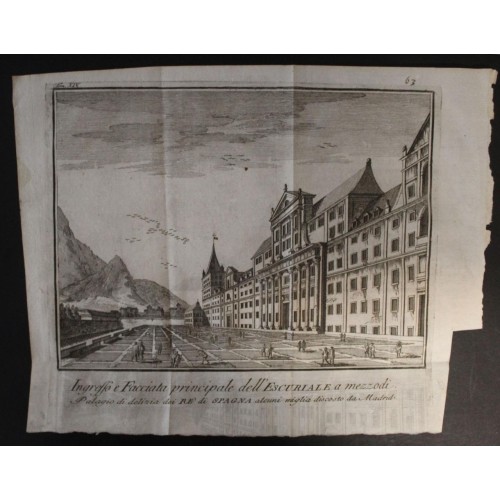
EL ESCORIAL SPAIN 1738 THOMAS SALMON ANTIQUE ORIGINAL COPPER ENGRAVED VIEW
ANTIQUE COPPER ENGRAVED VIEW OF EL ESCORIAL SPAIN 1738
Condition:
--not specified
Ended:Jul 30, 2022 , 7:15AM
Winning bid:
US $27.35
EL ESCORIAL SPAIN 1738 THOMAS SALMON ANTIQUE ORIGINAL COPPER ENGRAVED VIEW
Description
Ingresso e Facciata principale dell'Escoriale a mezzodi. Palagio di delizia dei Rи di Spagna alcuni miglia discosto da Madrid.
Description: Striking and highly detailed interesting 1738 Thomas Salmon's copper engraved view of the Facade of El Escorial, Spain. Several inhabitants adorn the view.
El Escorial, or the Royal Site of San Lorenzo de El Escorial (Spanish: Monasterio y Sitio de El Escorial en Madrid), or Monasterio del Escorial), is a historical residence of the King of Spain located in the town of San Lorenzo de El Escorial, 2.06 km (1.28 mi) up the valley (4.1 km [2.5 mi] road distance) from the town of El Escorial and about 45 kilometres (28 miles) northwest of the Spanish capital Madrid. Built between 1563 and 1584 by order of King Philip II (who reigned 1556–1598), El Escorial is the largest Renaissance building in the world. It is one of the Spanish royal sites and functions as a monastery, basilica, royal palace, pantheon, library, museum, university, school, and hospital.
El Escorial consists of two architectural complexes of great historical and cultural significance: the royal monastery itself and La Granjilla de La Fresneda, a royal hunting lodge and monastic retreat about 5 kilometres away. These sites have a dual nature: during the 16th and 17th centuries, they were places in which the power of the Spanish monarchy and the ecclesiastical predominance of the Roman Catholic religion in Spain found a common architectural manifestation. El Escorial was both a Spanish royal palace and a monastery, although Philip II is the only monarch who ever lived in the main building. Established with a community of Hieronymite monks, it has become a monastery of the Order of Saint Augustine. It was also a boarding school: the Real Colegio de Alfonso XII.
Philip II engaged the Spanish architect Juan Bautista de Toledo to be his collaborator in the building of the complex at El Escorial. Toledo had spent the greater part of his career in Rome, where he had worked on St. Peter's Basilica, and in Naples serving the king's viceroy, whose recommendation brought him to the king's attention. Philip appointed him architect-royal in 1559, and together they designed El Escorial as a monument to Spain's role as a center of the Christian world.
Date: 1738 ( undated )
Dimension: Paper size approx.: cm 24,8 x 19,4
Condition: Very strong and dark impression on good paper. Paper with chains and wiremarks. Map uncolored. Quite margin to the top. Wide lower margin. Wide lateral margins. Right lateral margin partially cut shortly at the lower side. Corners partially missing. Small foxing and browning. Plate folded. Conditions are as you can see in the images.
Mapmaker: Thomas Salmon (1679–1767) was an English historical and geographical writer. Born at Meppershall in Bedfordshire, and baptised there on 2 February 1679, was son of Thomas Salmon, by his wife Katherine, daughter of John Bradshaw; Nathanael Salmon was his elder brother. William Cole wrote that he wrote much of his work in Cambridge, where he ran a coffee house, and then moved to London. He told Cole that he had spent time at sea, and in both the East and West Indies for some time. He also travelled in Europe. In 1739–40 Salmon accompanied George Anson on his voyage round the world. He died on 20 January 1767.
Антикварная гравюра Эль-Эскориал, Королевский монастырь Сан-Лоренсо-де-Эль-Эскориал, 1738 , Thomas Salmon
Оригинальное название: "Ingresso e Facciata principale dell'Escoriale a mezzodi. Palagio di delizia dei Rи di Spagna alcuni miglia discosto da Madrid."
Гравюра - оттиск с медной пластины - 1738 года, выполненная Томасом Салмоном (Thomas Salmon), представляет собой высокодетализированный фасад монастыря Эль-Эскориал и является ценным историческим свидетельством архитектуры того времени.
Это классическая гравюра на меди, характерная для XVIII века. Она отличается четкостью линий, позволяющей рассмотреть мелкие детали фасада: окна, карнизы и строгую симметрию здания, спроектированного Хуаном де Эррерой.
На переднем плане изображены фигуры местных жителей и путешественников в одеждах той эпохи, что придает виду масштаб и оживляет монументальную архитектуру.
Эль-Эскориал, или Королевский монастырь Сан-Лоренсо-де-Эль-Эскориал (исп. Monasterio y Sitio de El Escorial en Madrid), — это историческая резиденция королей Испании. Построенный между 1563 и 1584 годами по приказу короля Филиппа II, Эль-Эскориал является крупнейшим зданием эпохи Возрождения в мире.
Работа была создана для масштабного труда Салмона «Modern History: or, the Present State of all Nations» (Современная история, или Текущее состояние всех народов), изданного в Лондоне.
Дата: 1738
Размер листа.: cm 24,8 x 19,4
Четкий оттиск на бумаге верже. Широкие поля. Издательский фальц
Отличное коллекционное состояние - см фото
Thomas Salmon (Томас Салмон) (1679–1767) английский антиквар и литератор, известный главным образом своими трудами по истории и географии («Modern history of present state of all nations»; «History of England»; «General description of England»; «The Chronological Historian»).
Много лет путешествовал по Европе и Востоку; совершил плавание вокруг света в составе экспедиции под началом английского адмирала Джорджа Энсона (Anson, 1697–1762). Во время своих путешествий делал записи, которые использовал потом в своих книгах, которые писал, поселившись под конец жизни в Кембридже, где содержал кофейню..
11715
11715
- Product Code: 11715
- Availability: In Stock
-
$0.00
- Ex Tax: $0.00