
в папке
07-0502026
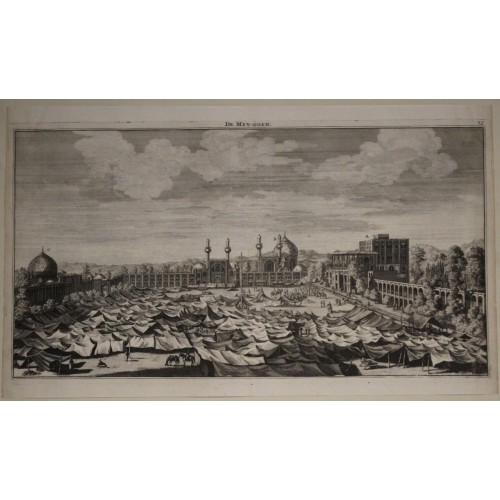
ISFAHAN NAQSH-E JAHAN SQUARE IRAN 1698 DE BRUYN UNUSUAL ANTIQUE ORIGINAL VIEW
ANTIQUE COPPER ENGRAVED VIEW OF NAQSH-E JAHAN SQUARE
Condition:
--not specified
Ended:
Jan 07, 2023 21:03:33 PST
Winning bid:
US $49.00
ISFAHAN NAQSH-E JAHAN SQUARE IRAN 1698 DE BRUYN UNUSUAL ANTIQUE ORIGINAL VIEW
Description
De Mey-doen.
Description: Striking and highly decorative interesting copper engraved panoramic view of the Naqsh-e Jahan Square, the market square in Ispahan, Iran, seen from the South, flanked by the Masjid-i-Sjah-Lutfullah mosque. Several inhabitans adorn the view.
Naqsh-e Jahan Square (Persian: гیПЗд дЮФ МеЗд Maidān-e Naghsh-e Jahān; trans: "Image of the World Square"), also known as the Shah Square (гیПЗд ФЗе) prior to 1979, is a square situated at the center of Isfahan, Iran. Constructed between 1598 and 1629, it is now an important historical site, and one of UNESCO's World Heritage Sites. It is 160 metres (520 ft) wide by 560 metres (1,840 ft) long (an area of 89,600 square metres (964,000 sq ft)). It is also referred to as Shah Square or Imam Square. The square is surrounded by buildings from the Safavid era. The Shah Mosque is situated on the south side of this square. On the west side is the Ali Qapu Palace. Sheikh Lotf Allah Mosque is situated on the eastern side of this square and at the northern side Qeysarie Gate opens into the Isfahan Grand Bazaar. Today, Namaaz-e Jom'eh (the Muslim Friday prayer) is held in the Shah Mosque.
Sheikh Lotfollah Mosque (Persian: гУМП ФیО бШЭ Зббе)[2] is one of the masterpieces of Iranian architecture that was built during the Safavid Empire, standing on the eastern side of Naqsh-i Jahan Square, Esfahan, Iran. Construction of the mosque started in 1603 and was finished in 1619. It was built by the chief architect Mohammadreza Isfahani, during the reign of Shah Abbas I of Persia. On the advice of Arthur Upham Pope, Reza Shah Pahlavi had the mosque rebuilt and repaired in the 1920s.
The sheet has been published in the Cornelis de Bruyn's travel book "Reizen van Cornelis de Bruyn, door de vermaardste deelen van Klein Asia, de eylanden Scio, Rhodus, Cyprus, Metelino, Stanchio, &c., mitsgaders de voornaamste steden van Aegypten, Syrien en Palestina".
Date: 1698 ( undated )
Dimension: Paper size approx.: cm 39,5 x 23,4
Condition: Very strong and dark impression. Sheet sticked on board on the verso. Sheet uncolored. Wide top and lower margins. Small lateral margins. Corners partially missing. Small foxing and browning. Conditions are as you can see in the images.
Mapmakers: Cornelis de Bruijn (also spelled Cornelius de Bruyn, pronounced (1652-1726/7) was a Dutch artist and traveler. He made two large tours and published illustrated books with his observations of people, buildings, plants and animals. Best known as a landscape artist, Le Bruyn travelled widely from a young age to Vienna, on to Rome then to Smyrna, Constantinople, Egypt, Jerusalem, Syria, Lebanon, and Turkey. Everywhere he went Le Bruyn depicted the scenes around him, he was especially interested in places of antiquity or historic interest, and his are the first images of the interior of a pyramid and Jerusalem to be widely available to Westerners. After an eight-year stay in Venice, Le Bruyn returned to The Hague in 1693 to publish this first book. From 1701 he started a second journey into Russia, Persia... This plate engraved by J. Mulder after R. du Val.
11572
- Product Code: 11572
- Availability: In Stock
-
$0.00
- Ex Tax: $0.00