
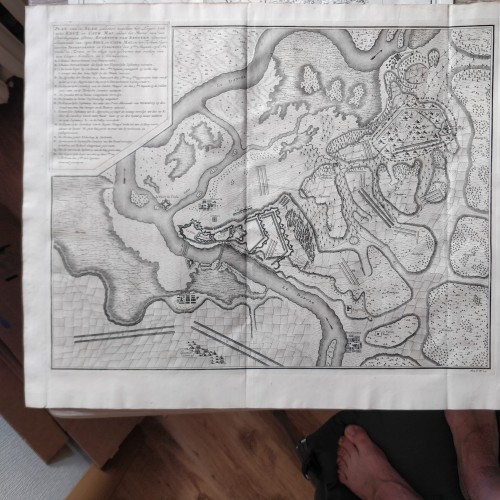
BATTLE OF PETROVARADIN SERBIA 1728 JEAN DUMONT ANTIQUE COPPER ENGRAVED MAP
ANTIQUE COPPER ENGRAVED MAP OF BATTLE OF PETROVARADIN
Condition:
--not specified
Ended:Jul 16, 2022 , 7:12AM
Winning bid:
US $31.00
BATTLE OF PETROVARADIN SERBIA 1728 JEAN DUMONT ANTIQUE COPPER ENGRAVED MAP
Description
Plan van de Slag gelevert tuschen het Leger van zyne en Cath. Maj. onder het bevel van den dovilugtigen Prins Eugenius Van Savoyen generaal Lieutenant van zyne Keys en Cath. Maj. en het Turkisch Leger tuschen Petervaradin en Carlowitz den 5 Augusti 1716 in welke de turkenopde Vlugt zyn gedevren met verlies van hun Camp Artillery en Ammunition.
Description: Striking and highly detailed fine unusual large copper engraved map of the area between Petrovaradin & Karlovci, Serbia, during the Battle of Petrovaradin, fought in 1716 at the time of the Seventh Ottoman-Venetian War. The map shows the city, mashes, rivers, islands and the location of the Armies A simple title cartouche adorn the sheet.
The Battle of Petrovaradin (Turkish: Petrovaradin Muharebesi), also known as the Battle of Peterwardein, took place on 5 August 1716 during the Austro-Turkish War when the Ottoman army besieged the Habsburgs-controlled fortress of Petrovaradin on the Military Frontier of the Habsburg monarchy (today Novi Sad, Vojvodina, Serbia). The Ottomans attempted to capture Petrovaradin, the so-called Gibraltar on the Danube, but experienced a great defeat by an army half the size of their own, similar to the defeat they had experienced in 1697 at Zenta. Ottoman Grand Vizier Damad Ali Pasha was fatally wounded, while the Ottoman army lost 20,000 men and 250 guns to the Habsburg army led by Field Marshal Prince Eugene of Savoy.
The Austrians consolidated this victory by marching into the Banat and conquering Temesvбr, the last remaining Turkish fortress in Hungary, followed by Belgrade.
Date: 1728 ( undated )
Dimension: Paper size approx.: cm 62,1 x 52,4
Condition: Very strong and dark impression on good paper. Paper with chains and wiremarks. Sheet uncolored. Wide top and lower margins. Quite right lateral margin. Wide left lateral margin. Corners partially missing. Small foxing and browning. Sheet folded. Conditions are as you can see in the images.
Writers: Jean Dumont Baron de Carlscroon (13 January 1667 – 13 May 1727) was a French writer and historian. He followed the profession of arms but, not obtaining promotion so rapidly as he expected, he left the service and travelled through different parts of Europe. He stopped in Holland with the intention of publishing an account of his travels. But in the interval, at the request of his bookseller, he wrote and published several pamphlets, which were eagerly sought after, owing to the unceremonious manner in which he treated the ministry of France. Thus deprived of all hope of employment in his own country, he thought of forming a permanent establishment in Holland, and accordingly commenced a course of lectures on public law. The project succeeded far beyond his expectations and some useful compilations which he published in the same period made him well known in other countries. The emperor appointed him his historiographer, and some time afterwards conferred on him the title of Baron de Carlscroon. He died in Vienna.
Dumont was also the author of Lettres historiques contenant ce qui se passe de plus important en Europe. This periodical, begun in 1692 with two volumes appearing annually, he edited until 1710, when it was continued by Jacques Basnage and others until 1728. The earlier volumes are much prized.
Jean Rousset de Missy (Laon, 26 August 1686–Uithoorn?, 13 August, 1762) was a French Huguenot writer, from early in life in the Netherlands. He was a renowned historian and author on international law and a prolific journalist. Born in Laon from Protestant parents (Jean Rousset and Rachel Cottin), he studied at the Collиge du Plessis in Paris. After a conflict with his stepmother he joined the Dutch States Army during the War of the Spanish Succession and was present at the Battle of Malplaquet (1709). In 1724 (after having founded and led a school for aristocratic boys in The Hague), he started his activities as a professional journalist. He worked together with Jean Dumont de Carelskroon (1667–1727), jurist of Charles VI, Holy Roman Emperor, and author of the "Corps Universel Diplomatique du Droit des Gens", to which he published an addition in 1739. Rousset and Dumont wrote a military account of the War of the Spanish Succession, illustrated by the Dutch engraver and painter Jan van Huchtenburg. Rousset also treated Russia under Czarina Catherine I, and Peter the Great and Spain under King Philip V.
Engravers: J(oh)an and Jacob van Huchtenburg (Hughtenburg or Hugtenburg(h)) were two Dutch Golden Age painters in the second half of the seventeenth century. Both brothers were natives of Haarlem, moved to Paris, but died in Amsterdam. The main source about their lives is from Arnold Houbraken. Some of the information from the 19th century is contradictive.
Jacob van Huchtenburg (1644, Haarlem - bur. January 8, 1675, Amsterdam) studied under Nicolaes Pieterszoon Berchem. In 1662 he went to Italy and stayed in Rome until 1667. On his way back to Holland he stayed in Paris for more than a year, where he probably met up with his brother Jan. In 1669 he joined the Haarlem artists' guild. His pictures are probably confounded with those of his brother. He became well-to-do and lived on Prinsengracht. One is in the Brukenthal Museum, Sibiu.
Jan van Huchtenburg (bapt. November 20, 1647, Haarlem - bur. July 2, 1733, Amsterdam), was a famous Dutch horse and battle painter, like Esaias van de Velde and Philip Wouwermans. He was first taught by Thomas Wijck. On his way to visit his brother in Rome, he may not have got further than Paris, where he served under Antony Francis van der Meulen in the Manufacture des Gobelins employing him for illustrating, sketching or designing.
10924
- Product Code: 10924
- Availability: In Stock
-
$0.00
- Ex Tax: $0.00