
BOX 21-01-25
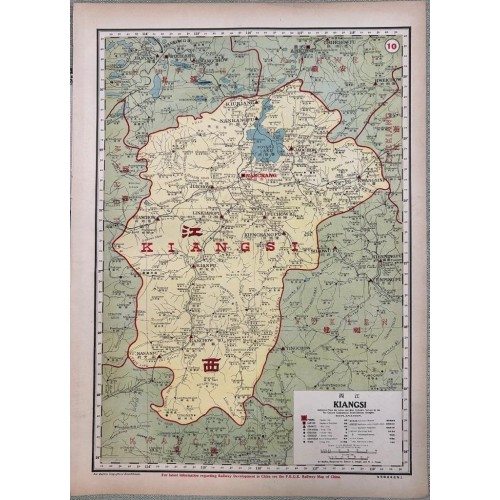
JIANGXI CHINA 1917 DINGLE ANTIQUE ORIGINAL COLORED LITHOGRAPHIC ENGRAVED MAP
ANTIQUE ORIGINAL COLORED LITHOGRAPHIC MAP OF JIANGXI
old times rare books and maps
old times rare books and maps
(19538)
100% positiveSeller's other itemsSeller's other itemsContact seller
US $29.00
JIANGXI CHINA 1917 DINGLE ANTIQUE ORIGINAL COLORED LITHOGRAPHIC ENGRAVED MAP
Description
KIANGSI Compiled From the Latest and Most Authentic Survey by the Far Eastern Geographical Establishment, Shangai.
Description: Striking and highly detailed interesting original colored lithographic map of Jiangxi, China. The map notes cities, towns, roads, rivers and lakes as well as administrative divisions. A block-style title cartouche include a legend key & two mileage scales adorn the map. Text in English and Chinese.
Date: 1917 ( undated )
Dimension: Paper size approx.: cm 38,8 x53,7
Condition: Very strong and dark impression on good paper. Map old original colored. Small foxing and browning. Map folded. Conditions are as you can see in the images.
Mapmaker: Edwin John Dingle (6 April 1881, Cornwall – 27 January 1972) was an English journalist, author and founder of the Institute of Mentalphysics in California, US. He was also a Fellow of the Royal Geographical Society of Great Britain.
Dingle claimed to have learned advanced spiritual disciplines from a Tibetan mystic, and styled himself as a spiritual teacher with the name Ding Le Mei (Chinese: ???). As the President and Preceptor Emeritus of the Institute of Mentalphysics, he described himself as a "psychologist, author and philosopher".
Edwin J. Dingle was born in Cornwall, England and became an orphan at nine. As a journalist, Dingle moved to Singapore (Straits Settlements) in 1900 to cover the affairs of the Far East. He was one of the first Caucasians to go into China and to actually stay for a substantial period of time in a Tibetan Monastery. There, he learnt meditation and yoga from a teacher.
In 1910, he travelled to Tibet and stayed there for nine months. He claimed to have learned closely guarded advanced spiritual methods from the Tibetan Lamas. These techniques included the "Eight Key Breaths", a form of pranayama. He spent nearly 21 years in the Asia, in China, India, Tibet and Burma. During the 1911 Revolution, he was in Wuhan and then Shanghai. He witnessed the brutal civil wars in Hankou and Hanyang. He later wrote a book to tell his personal experience during the revolution. He spoke highly of Li Yuanhong, Yuan Shikai and Sun Yatsen. In many ways, he sympathised with the revolution but believed that Yuan could be able to be a unifier of the country.
In 1917, the North China Daily News & Herald of Shanghai published his The New Atlas and Commercial Gazetteer of China, which was devoted to China's "geography & resources and economic & commercial development". The book served as a standard reference for years, and was described by the Millard's Review of the Far East as "The biggest and best book on the resources of China". After his return to England, Dingle also wrote about his experiences in the East which were eventually published as the book Across China on Foot by Earnshaw Books.
3726
- Product Code: 3726
- Availability: In Stock
-
$0.00
- Ex Tax: $0.00