
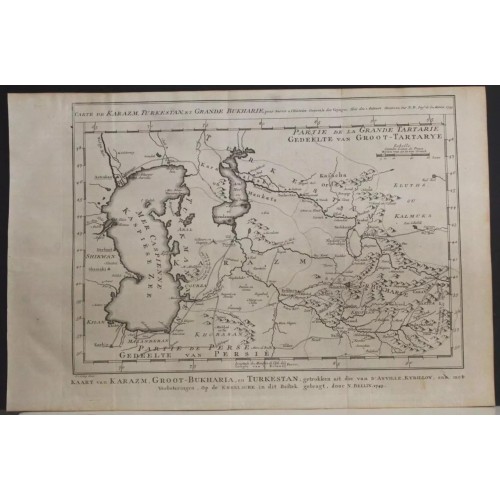
CASPIAN & ARALSEAS CENTRAL ASIA 1749 BELLIN & VAN SCHLEY ANTIQUE ORIGINAL MAP
ANTIQUE COPPER ENGRAVED MAP OF THE CENTRAL ASIA 1749
old times rare books and maps
(20333)
100% positiveSeller's other itemsSeller's other itemsContact seller
US $21.50
CASPIAN & ARALSEAS CENTRAL ASIA 1749 BELLIN & VAN SCHLEY ANTIQUE ORIGINAL MAP
Description
Carte de Karazm, Turkestan et Grande Bukarie pour Servir a l'Histoire Generale des Voyages. Tirйe des Auteurs Anglois, Par N. Bellin Ing.r de la Marine 1749. // Kaart van Karazm, Groot-Bukharia, en Turkestan, getrokken uit die van d'Anville, Kyrillow, enz. met Verbeteringen. Op de Engelsche in dit Bestek gebragt, door N. Bellin 1749.
Description: Striking and highly detailed fine unusual 1749 Jacques-Nicolas Bellin copper engraved map of centered on Turkestan. It extends to include the Aral and Caspian Seas, Uzbekistan, Tajikistan, Turkmenistan and northern parts of Iran and Afghanistan. THe map notes cities, towns, rivers, lakes and reliefs.
A French title to the top along netline, a strapwork mileage cartouche and an alternative Dutch title to the lower side adorn the sheet.
This map, engraved by Jacob van der Schley, has been published in the Dutch edition of Abbи Presvost’s “Histoire Gйnйrale des Voyages”, published at The Hague, 1747-1780.
Source: The Histoire Gйneral des Voyages was a monumental eighteenth century general history divided according to geographic region. The original volumes were written by Antoine Franзois Prйvost d'Exiles, a French author, novelist, theologian, natural historian, and a priest of the Jesuit and Benedictine orders, but continued by numerous other authors after Prйvost's death. The earliest books mostly deal with the Far East and South-East Asia, providing a general history of their regions, kingdoms, customs, culture, costumes, natural phenomena and religious beliefs. Much of Prйvost's information is derived from the reports of Jesuit missionaries, Portuguese merchants, and famous explorers, from Marco Polo to Sir Francis Drake. Although written in French, the popularity of the Histoire among Dutch audiences meant that many of the illustrative plates and maps published to accompany the work were either re-engraved or subtitled in Dutch by the engraver Jakob van der Schley. Prйvost himself had travelled widely throughout the Netherlands, launching his literary career in Amsterdam and the Hague after fleeing the Benedictines in France. Prevost's work on China, and indeed many of van der Schley's plates, owe a great debt to Johan Nieuhoff (1618-1672) , a Dutch traveller who explored much of China, India, and Brazil while in the employ of the Dutch East India Company. Nieuhoff wrote extensively, with a particular focus on China, for his memoirs, and his numerous drawings of Chinese places and people were much copied by later engravers for numerous works of Chinese interest. Nieuhoff's own book became a major source of inspiration for eighteenth century chinoiserie, and are amongst the first western illustrations to depict the Chinese people in a manner which was based upon personal observation rather than the tradition of oriental fantasy.
Date: 1749 ( dated )
Dimension: Paper size approx.: cm 37,5 x 24,9
Condition: Very strong and dark impression on good paper. Paper with chains and wiremarks. Map uncolored. Short margin to the top. Good lower margin. Wide lateral margins. Small foxing and browning. Map folded. Conditions are as you can see in the images.
Mapmaker: Jacques-Nicolas Bellin (1703 - March 21, 1772) was one of the most important cartographers of the 18th century. With a career spanning some 50 years, Bellin is best understood as geographe de cabinet and transitional mapmaker spanning the gap between 18th and early-19th century cartographic styles. His long career as Hydrographer and Ingйnieur Hydrographe at the French Dйpфt des cartes et plans de la Marine resulted in hundreds of high quality nautical charts of practically everywhere in the world. A true child of the Enlightenment Era, Bellin's work focuses on function and accuracy tending in the process to be less decorative than the earlier 17th and 18th century cartographic work. Unlike many of his contemporaries, Bellin was always careful to cite his references and his scholarly corpus consists of over 1400 articles on geography prepared for Diderot's Encyclopedie. Bellin, despite his extraordinary success, may not have enjoyed his work, which is described as "long, unpleasant, and hard." In addition to numerous maps and charts published during his lifetime, many of Bellin's maps were updated (or not) and published posthumously. He was succeeded as Ingйnieur Hydrographe by his student, also a prolific and influential cartographer, Rigobert Bonne.
Engraver: Jacob Van der Schley (1715 - 1779) was a prominent Amsterdam engraver and draftsman based out of Amsterdam. Schley apprenticed under portrait engraver Bernard Picart, whose style he imitated. He is said to have completed several of Picart's portraits following his master's death. While Schley is primarily known for his work as a portraitist and illustrator, he also has a considerable cartographic corpus. He is known to have worked with Bellin, Hondt, and Provost, among others.
Writer: Antoine Franзois Prйvost d'Exiles (1 April 1697 – 25 November 1763), usually known simply as the Abbй Prйvost, was a French author and novelist.
He was born at Hesdin, Artois, and first appears with the full name of Prйvost d'Exiles, in a letter to the booksellers of Amsterdam in 1731. His father, Lievin Prйvost, was a lawyer, and several members of the family had embraced the ecclesiastical estate. Prйvost was educated at the Jesuit school of Hesdin, and in 1713 became a novice of the order in Paris, pursuing his studies at the same time at the college in La Flиche.
At the end of 1716 he left the Jesuits to join the army, but soon tired of military life, and returned to Paris in 1719, apparently with the idea of resuming his novitiate. He is said to have travelled in the Netherlands about this time; in any case he returned to the army, this time with a commission. Some biographers have assumed that he suffered some of the misfortunes assigned to his hero Des Grieux. Whatever the truth, he joined the learned community of the Benedictines of St Maur, with whom he found refuge, he himself says, after the unlucky termination of a love affair. He took his vows at Jumiиges in 1721 after a year's novitiate, and in 1726 took priest's orders at St Germer de Flaix. He spent seven years in various houses of the order, teaching, preaching and studying. In 1728 he was sent to the Abbey of Saint-Germain-des-Prйs, Paris, where he contributed to the Gallia Christiana, a work of historiographic documentation undertaken communally by the monks in continuation of the works of Denys de Sainte-Marthe, who had been a member of their order. His restless spirit made him seek from the Pope a transfer to the easier rule of Cluny; but he left the abbey without leave (1728), and, learning that his superiors had obtained a lettre de cachet against him, fled to England.
In London he acquired a wide knowledge of English history and literature, as can be seen in his writings. Before leaving the Benedictines Prйvost had begun perhaps his most famous novel, Mйmoires et aventures d’un homme de qualitй qui s’est retirй du monde, the first four volumes of which were published in Paris in 1728, and two years later at Amsterdam. In 1729 he left England for the Netherlands, where he began to publish (Utrecht, 1731) a novel, the material of which, at least, had been gathered in London Le Philosophe anglais, ou Histoire de Monsieur Cleveland, fils naturel de Cromwell, йcrite par lui-mкme, et traduite de l'anglais (Paris 1731-1739, 8 vols., but most of the existing sets are partly Paris and partly Utrecht). A spurious fifth volume (Utrecht, 1734) contained attacks on the Jesuits, and an English translation of the whole appeared in 1734.
Meanwhile, during his residence at the Hague, he engaged on a translation of De Thou's Historia, and, relying on the popularity of his first book, published at Amsterdam a Suite in three volumes, forming volumes v, vi, and vii of the original Mйmoires et aventures d’un homme de qualitй. The seventh volume contained the famous Manon Lescaut, separately published in Paris in 1731 as Histoire du Chevalier des Grieux et de Manon Lescaut. The book was eagerly read, chiefly in pirated copies, being forbidden in France. In 1733 he left the Hague for London in company of a lady whose character, according to Prйvost's enemies, was doubtful. In London he edited a weekly gazette on the model of Joseph Addison's Spectator, Le Pour et contre, which h e continued to produce in collaboration with the playwright Charles-Hugues Le Febvre de Saint-Marc, with short intervals, until 1740.
In the autumn of 1734 Prйvost was reconciled with the Benedictines, and, returning to France, was received in the Benedictine monastery of La Croix-Saint-Leufroy in the diocese of Йvreux to pass through a new, though brief, novitiate. In 1735 he was dispensed from residence in a monastery by becoming almoner to the Prince de Conti, and in 1754 obtained the priory of St Georges de Gesnes. He continued to produce novels and translations from the English, and, with the exception of a brief exile (1741–1742) spent in Brussels and Frankfurt, he resided for the most part at Chantilly until his death, which took place suddenly while he was walking in the neighbouring woods. The cause of his death, the rupture of an aneurysm, is all that is definitely known. Stories of crime and disaster were related of Prйvost by his enemies, and diligently repeated, but appear to be apocryphal.
12249
- Product Code: 12249
- Availability: In Stock
-
$0.00
- Ex Tax: $0.00