
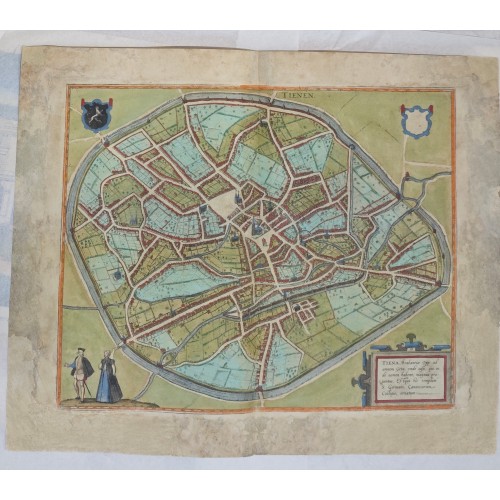
TIENEN BELGIUM 1581 BRAUN & HOGENBERG UNUSUAL ANTIQUE COPPER ENGRAVED CITY VIEW
ANTIQUE COPPER ENGRAVED CITY VIEW OF TIENEN BELGIUM
old times rare books and maps
(20116)
100% positiveSeller's other itemsSeller's other itemsContact seller
US $81.00
TIENEN BELGIUM 1581 BRAUN & HOGENBERG UNUSUAL ANTIQUE COPPER ENGRAVED CITY VIEW
Description
Tienen. - Tiena Brabantiae Opp: ad amnem Geta, unde casei, qui inde nomen habent, magnus prouentus, estque hic templum S. Germanni, Canonicorum Collegio, ornatum.
Description: Striking and highly detailed fine unusual copper engraved map featuring a bird's-eye view of Tienen, Belgium. The view shows the city with his buildings, churches, streets, gardens, town walls and surrounding landscape. A simple title at the top central side, an ornamental alternative title cartouche, two Armorials and two inhabitants in their typical dresses adorn the view. Latin text on verso.
TRANSLATION OF CARTOUCHE TEXT: Tienen, Brabantine town on the Geta, from whence comes much cheese, which is named after it. There is also a church of St Germain and a college of canons here.
COMMENTARY BY BRAUN: "That Tienen was once a large and important trade town is not only related in all the chronicles but is evident, too, from the buildings that can still be viewed today: the city was namely enlarged and encircled with new walls four times. Before its decline, as a result of which 's-Hertogenbosch experienced an economic upswing, it was the fourth-largest city in Brabant, but in the course of fierce wars between the Brabantines, the French and the Eburones, it was captured and destroyed more than once, so that some parts of the town are uninhabited."
The plan view from the southwest shows the formerly more populous Belgian town lying within extensive walls encompassing farmlands and fields. The large church of Sint-Germanus is on the open ground on the old cattle market in the city's centre. Behind it to the left is the Grote Markt, part of which lies on drained marshland, whence the name of the Gothic church on the square's east side: Onze-Lieve-Vrouw-ten-Poel. Tienen was probably founded around AD 800 by the Holstein branch of the Thienen-Adlerflycht dynasty on a site already inhabited in Celtic times. In the late Middle Ages, the town lived from cloth weaving, caught up in wars in the 16th century. However, it rapidly declined, and 1635 was almost destroyed.
Braun G. & Hogenberg F. and the Civitates Orbis Terrarum.
The Civitates Orbis Terrarum, or the "Braun & Hogenberg", is a six-volume town atlas and the greatest book of town views and plans ever published: 363 engravings, sometimes beautifully coloured. It was one of the best-selling works in the last quarter of the 16th century. Georg Braun wrote the text accompanying the plans and views on the verso. A large number of the plates were engraved after the original drawings of Joris Hoefnagel (1542-1600), who was a professional artist. The first volume was published in Latin in 1572, and the sixth in 1617. Frans Hogenberg created the tables for volumes I through IV, and Simon van den Neuwel created those for volumes V and VI. Other contributors were cartographers Daniel Freese and Heinrich Rantzau. Works by Jacob van Deventer, Sebastian Mьnster, and Johannes Stumpf were also used. Translations appeared in German and French.
Following the original publication of Volume 1 of the Civitates in 1572, seven further editions of 1575, 1577, 1582, 1588, 1593, 1599 and 1612 can be identified. Vol.2, first issued in 1575, was followed by further editions in 1597 and in 1612. The next volumes appeared in 1581, 1588, 1593, 1599 and 1606. The German translation of the first volume appeared from 1574 on, and the French edition from 1575 on.
Several printers were involved: Theodor Graminaeus, Heinrich von Aich, Gottfried von Kempen, Johannis Sinniger, Bertram Buchholtz and Peter von Brachel, who all worked in Cologne.
Date: 1581 ( undated )
Dimension: Paper size approx.: cm 51,4 x 41,8
Condition: Very strong and dark impression on good paper. Paper with chains. Plate old original colored. Wide margins. Corners partially missing and redone. Small foxing and browning. Small holes partially restored. Sheet reinforced with contemporary paper. Plate folded. Conditions are as you can see in the images.
Mapmakers: Georg Braun (also Brunus, Bruin; 1541 – 10 March 1622) was a topo-geographer. From 1572 to 1617 he edited the Civitates orbis terrarum, which contains 546 prospects, bird's-eye views and maps of cities from all around the world. He was the principal editor of the work, he acquired the tables, hired the artists, and wrote the texts. He died as an octogenarian in 1622, as the only survivor of the original team to witness the publication of volume VI in 1617.
Braun was born and died in Cologne. His principal profession was as a Catholic cleric, however, he spent thirty-seven years as canon and dean at the church, St. Maria ad Gradus, in Cologne. His six-volume work was inspired by Sebastian Mьnster's Cosmographia. In form and layout it resembles the 1570 Theatrum orbis terrarum by Abraham Ortelius, as Ortelius was interested in a complementary companion for the Theatrum.
The Braun publication set new standards in cartography for over 100 years. Frans Hogenberg (1535–1590, from Mechelen) created the tables for volumes I through IV, and Simon van den Neuwel created those for volumes V and VI. Other contributors were Joris Hoefnagel, Jacob Hoefnagel, cartographer Daniel Freese, and Heinrich Rantzau. Works by Jacob van Deventer, Sebastian Mьnster, and Johannes Stumpf were also used. Primarily European cities are depicted in the publication; however, Casablanca and Mexico City/Cuzco on one sheet[4] are also included in volume I.
Frans Hogenberg (1535–1590) was a Flemish and German painter, engraver, and mapmaker.
Hogenberg was born in Mechelen as the son of Nicolaas Hogenberg. In 1568 he was banned from Antwerp by the Duke of Alva and travelled to London, where he stayed a few years before emigrating to Cologne. He is known for portraits and topographical views as well as historical allegories. He also produced scenes of contemporary historical events.
Hogenberg died in Cologne.
12167
- Product Code: 12167
- Availability: In Stock
-
$0.00
- Ex Tax: $0.00