
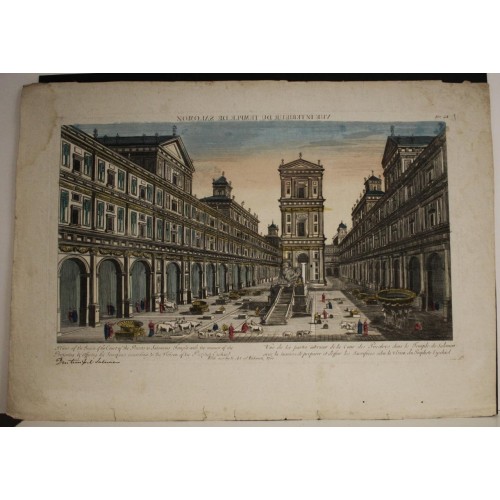
ERUSALEM SOLOMON'S TEMPLE ISRAEL 1760 ACT OF PARLIAMENT ANTIQUE OPTICAL VIEW See original
Jun 12, 2022
Winning bid:US $21.62
JERUSALEM SOLOMON'S TEMPLE ISRAEL 1760 ACT OF PARLIAMENT ANTIQUE OPTICAL VIEW
Description
Aview of the Inside of the Court of the Priest in Salomons Temple with the manner of the Preparing & Offering the Sacrifices according to the Vision of the Prophet Ezckiel. // Vue de la partie interieur de la Cour des Prestes dans le Temple de Salomon avec la maniere de preparer et d'ffrir les Sacrifices selon la Vision du Prophete Ezechiel.
Description: Striking and highly detailed fine unusual 1760 copper engraved so-called optical view featuring the Courtyard of the Priests inside the Solomon's Temple with the Heikal and the Holy of the Holies, at Jeruslaem, Israel. The view shows the Molten Sea, the washrooms and the altar of sacrifices. Several inhabitants complete the view. Reverse title to the top.
The courtyard of the priests contained the altar of sacrifices (Chronicles II 15: 8), the bronze wash (4: 2-5, 10), and ten wash houses (Kings I 7:38, 39).
From King II 16:14 it is clear that there was a bronze altar in front of the Temple; Chronicles II 4: 1 describes it as a parallelepiped with a square base 20 cubits wide and 10 cubits high.
The bronze wash, 10 cubits wide (1 cubit = 45 cm) and 5 cm deep, was supported by twelve bronze oxen (Re I 7: 23-26). The Book of Kings defines it as having a capacity of two thousand bat (1 bat = 45 liters), while the Book of Chronicles brings the capacity to three thousand bat (Chronicles II 4: 5-6) and describes its function: to allow ablutions to priests; regarding the discrepancy regarding the capacity, the exegetes of the interfaith Bible TOB believe that "perhaps it is due to errors attributable to the copyists that 1King7,26 speaks of 2,000 bat and our text [2cro4,5] of 3,000 bat".
The wash houses, each of which contained forty baths (King I 7:38), rested on bronze lifting poles, with wheels, and decorated with figures of lions, cherubs and palms. These vessels aroused the admiration of the Jews. The editor of the Book of Kings eagerly describes the finest details. (Kings I 7: 27-37).
Josephus in the Jewish Antiquities states that these were of orichalcus.
According to King I 7:48 in front of the Sancta Sanctorum there was an altar for incense and a table for bread. The table was of gold, as were the five candlesticks on each of its sides. The accessories of the candelabra - snuffers and braziers - were gold, like the hinges of the doors
Sanctuary (main chamber)
The porch led to the heikal, main chamber, or sanctuary. It measured 40 cubits in length, 20 cubits in width, and 30 cubits in height and contained a candelabrum, a table and a gold-covered altar used for offerings. In the sanctuary, loaves of Showbread were left as an offering to God. At the far end of the sanctuary there was a wooden door, guarded by two cherubim, leading to the Holy of Holies.
The walls of the sanctuary were lined with cedar, on which were carved figures of cherubim, palm trees, and open flowers, which were overlaid with gold (1 Kings 6:29-30). Chains of gold further marked it off from the Holy of Holies. The floor of the Temple was of fir overlaid with gold. The doorposts, of olivewood, supported folding doors of fir. The doors of the Holy of Holies were of olivewood. On both sets of doors were carved cherubim, palm trees, and flowers, all being overlaid with gold (1 Kings 6:15 et seq.) This main building was between the outer altar, where most sacrifices were performed, and inside at the far end was the entry to the Holy of Holies, originally containing the Ark of the Covenant. The main hekhal contained a number of sacred ritual objects including the seven-branched candlestick, a golden Altar of Incense, and the table of the showbread. According to 1 Kings 7:48 these tables were of gold, as were also the five candlesticks on each side of the altar. The candle-tongs, basins, snuffers, fire-pans, and even the hinges of the doors were also gold.
Holy of Holies
The Holy of Holies, also called the "Inner House," was 20 cubits in length, breadth, and height. The usual explanation for the discrepancy between its height and the 30-cubit height of the temple is that its floor was elevated, like the cella of other ancient temples. It was floored and wainscotted with cedar of Lebanon, and its walls and floor were overlaid with gold amounting to 600 talents or roughly 20 metric tons. It contained two cherubim of olive-wood, each 10 cubits high and each having outspread wings of 10 cubits span, so that, since they stood side by side, the wings touched the wall on either side and met in the center of the room. There was a two-leaved door between it and the Holy Place overlaid with gold; also a veil of tekhelet (blue), purple, and crimson and fine linen. It had no windows and was considered the dwelling-place of the "name" of God.
The Holy of Holies was prepared to receive and house the Ark; and when the Temple was dedicated, the Ark, containing the original tablets of the Ten Commandments, was placed beneath the cherubim.
The Vues d'optique were specifically developed to provide the illusion of depth when viewed through a zograscope, also known as an "optical diagonal machine" or viewers with similar functions.
The optical views were meant to be seen with a special viewer to enhance the three dimensional effect, a zograscope. This is an optical device for enhancing the sense of depth perception from a flat picture.
It consists of a large magnifying lens through which the picture is viewed. Some models have the lens mounted on a stand in front of an angled mirror. This allows someone to sit at a table and to look through the lens at the picture flat on the table. Pictures viewed in this way need to be left-right reversed; this is obvious in the case of
writing. A print made for this purpose is called a vue d’optique or perspective view. They were very popular in the 18th and 19th centuries. The colouring is often bright and naпve, as for children’s illustrations. Travelling vendors who went around to fairs offering these views, often did the handcolouring themselves, so it tends to be a bit rough compared with other period engravings.
Date: 1760 ( undated )
Dimension: Paper size approx.: cm 45,6 x 31,9
Condition: Very strong and dark impression on good paper. Paper with chains and wiremarks. Plate old original colored. Wide margins. Corners partially missing. Small foxing and browning. Small marginal tears and holes. Small waterstains. Conditions are as you can see in the images.
Антикварная цветная гравюра Вид внутренней части двора в храме Соломона с жертвенником согласно видению пророка Иезкиля, издание 1760
Оригинальное название: A view of the Inside of the Court of the Priest in Salomons Temple with the manner of the Preparing & Offering the Sacrifices according to the Vision of the Prophet Ezckiel. // Vue de la partie interieur de la Cour des Prestes dans le Temple de Salomon avec la maniere de preparer et d'ffrir les Sacrifices selon la Vision du Prophete Ezechiel.
Дата: 1760 ( недатированная )
Четкий и высокодетализированный оттиск с медной пластины с ручной акварельной раскраской 1760 выполненный в технике Vue d'Optiqu
Vue d'Optique или Guckkastenblatt (перспективный вид) - особый вид старых офортов, предназначенный для просмотра в камере через линзу, которая увеличивала изображение и давала иллюзию трёхмерности. Эти камеры назывались зограскопами или «peep show boxes» (to peep -заглядывать). Чаще всего «перспективные виды» изображали крупные города и знаменитые архитектурные памятники, напоминали о путешествиях, представляли библейские сцены - листы были контрастно выгравированы и раскрашены акварелью. Некоторые виды и сцены демонстрировались с подсветкой из свечей. "Vue d'Optique" впервые появились в Англии, и во второй половине 18 века распространились по Европе. Основными центрами производства "Vue d'Optique" стали Аугсбург и Париж. "Vue d'Optique" демонстрировались в "peep show boxes" на ярмарках. Обеспеченная публика стала приобретать такие устройства для домашнего использования, а также коллекционировать "Vue d'Optique".
В отличном коллекционном состоянии - см фото
Размер листа 45,5 x 30 cm
Обратная сторона чистая
10363
10363
- Product Code: 10363
- Availability: In Stock
-
$0.00
- Ex Tax: $0.00