
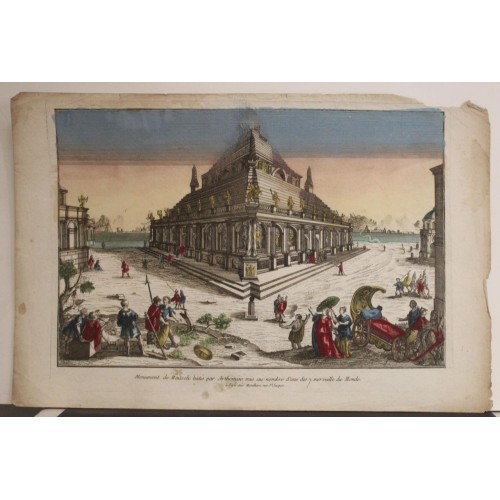
MAUSOLEUM HELICARNASSUS TURKEY 1770ca MONDHARE ANTIQUE ORIGINAL OPTICAL VIEW
ANTIQUE ORIGINAL OPTICAL VIEW MAUSOLEUM HELICARNASSUS
MAUSOLEUM HELICARNASSUS TURKEY 1770ca MONDHARE ANTIQUE ORIGINAL OPTICAL VIEW
Description
Monument de Mausoli batis par Arthemise mis au nombre d'une de 7. merveille du Monde.
Description: Striking and highly detailed fine unusual 1770ca Louis-Joseph Mondhare's copper engraved so-called optical view of the Mausoleum of Halicarnassus. Several inhabitants adorn the view.
The Mausoleum at Halicarnassus or Tomb of Mausolus (Ancient Greek: Мбхущлеῖпн фῆт Ἁлйкбснбуупῦ; Turkish: Halikarnas Mozolesi) was a tomb built between 353 and 350 BC in Halicarnassus (present Bodrum, Turkey) for Mausolus, an Anatolian from Caria and a satrap in the Achaemenid Empire, and his sister-wife Artemisia II of Caria. The structure was designed by the Greek architects Satyros and Pythius of Priene. Its elevated tomb structure is derived from the tombs of neighbouring Lycia, a territory Mausolus had invaded and annexed c. 360 BC, such as the Nereid Monument.
The Mausoleum was approximately 45 m (148 ft) in height, and the four sides were adorned with sculptural reliefs, each created by one of four Greek sculptors: Leochares, Bryaxis, Scopas of Paros, and Timotheus. The Mausoleum contained total 400 freestanding sculptures The mausoleum was considered to be such an aesthetic triumph that Antipater of Sidon identified it as one of his Seven Wonders of the Ancient World. It was destroyed by successive earthquakes from the 12th to the 15th century; it was the last surviving of the six destroyed wonders.
The word mausoleum has now come to be used generically for an above-ground tomb.
The Vues d'optique were specifically developed to provide the illusion of depth when viewed through a zograscope, also known as an "optical diagonal machine" or viewers with similar functions.
Date: 1770ca ( undated )
Dimension: Paper size approx.: cm 50,1 x 32,8
Condition: Very strong and dark impression on good paper. Paper with chains. Plate old original colored. Wide margins. Corners partially missing. Small foxing. Small browning. Small marginal tears. Conditions are as you can see in the images.
Publisher: Louis-Joseph Mondhare (1734 - August 21, 1796) was a French engraver and publisher of maps, prints and vues d'optique active in the second half of the 18th century. Mondhare was born in Bougy (Calvados) and moved to Paris on or before 1759. He began publishing around 1760 under the Chez Mondhare imprint. On June 7 of 1784, his son-in-law Pierre Jean (1754-1829) joined the business and they changed their imprint to Mondhare & Jean. The Mondhare firm maintained their office in Paris on Rue St. Jacques, at the Hфtel Saumar, a well-known location for print sellers near St. Severin. Later they relocated to 32 Rue Saint-Jean de Beauvais. The firm ceased operation around 1796. Mondhare died shortly afterward in 1799. His name variantly appears on some imprints as Mondar or Mondhard.
5823
- Product Code: 5823
- Availability: In Stock
-
$0.00
- Ex Tax: $0.00