
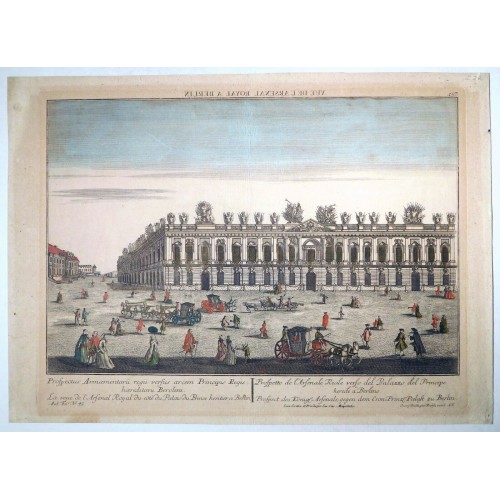
Spy Box Leaf, Stuff house in Berlin, G.B. Probst, ~ 1780, K 13, Crown Prince Palais- ??? ????????
Антикварная Большая Цветная Гравюра Здание Арсенала в Берлине 1780 (10074)
Антикварная цветная гравюра - оттиск с медной пластин - Арсенала в Берлине, изданная около 1780 года.
Лист с изображением Арсенала в Берлине. Вид с угла на двухэтажный арсенал в стиле барокко, украшенный скульптурой из мастерской Андреаса Шютера (Andreas Schьter). На заднем плане слева видна улица Унтер-ден-Линден с Кронпринценпале (Unter den Linden with the Kronprinzenpalais). На переднем плане многочисленные стаффажные фигуры в стиле барокко и несколько карет.
Внизу оригинальная надпись на латине, французском, итальянском и немецких языках, а внизу справа адрес аугсбургского издателя Георга Бальтазара Пробста (Georg Balthasar Probst) (1732-1801). Слева от этого имперская привилегия печати. Слева внизу порядковый номер: 42. В правом верхнем углу текущий номер: 157. Гравюра одна из четырех листов с видами Берлина. Это копия с офорта Иоганна Давида Шлейена (Johann David Schleuen) (1711-1771).
Антикварная цветная гравюра издана для системы Vue d’Optique (Перспективного вида), предназначенного для просмотра в камере через линзу.
Vue d'Optique или Guckkastenblatt (перспективный вид) - особый вид старых офортов, предназначенный для просмотра в камере через линзу, которая увеличивала изображение и давала иллюзию трёхмерности. Эти камеры назывались зограскопами или «peep show boxes» (to peep -заглядывать). Чаще всего «перспективные виды» изображали крупные города и знаменитые архитектурные памятники, напоминали о путешествиях, представляли библейские сцены - листы были контрастно выгравированы и раскрашены акварелью. Некоторые виды и сцены демонстрировались с подсветкой из свечей. "Vue d'Optique" впервые появились в Англии, и во второй половине 18 века распространились по Европе. Основными центрами производства "Vue d'Optique" стали Аугсбург и Париж. "Vue d'Optique" демонстрировались в "peep show boxes" на ярмарках. Обеспеченная публика стала приобретать такие устройства для домашнего использования, а также коллекционировать "Vue d'Optique".
Размер листа: 34,7 x 47,8 cm
Размер изображения: 31,9 x 42,6 cm
В хорошем состоянии - имеются пятна старения, небольшие загрязнения. На обратной стороне подклеена тонкая монтажная планка по окружности. Бумага верже. Обратная сторона чистая
1780 View d'optique of the Royal Armory in Berlin A Hand Colored Engraving Georg Balthasar Probst
1780 Vue d'optique: Prospect des Koenigl. Arsenals, gegen dem Cron-Prinzl. Palast zu Berlin Georg Balthasar Probst
A 18th century copper-plate hand colored Vue d'optique engraving entitled: "Prospectus Armamentarii Regii Versus Arcem Principis Regis Haereditarii" (View of the royal Armory in Berlin), published in Augsburg, Germany in 1780 by Georg Balthasar Probst (1732-1801) a German publisher, printer and printmaker.
Proscenium sheet with a depiction of the Arsenal in Berlin. Slightly oblique view of the two-story baroque armory with the elaborate building sculpture from the workshop of Andreas Schьter. In the background on the left you can see the street Unter den Linden with the Kronprinzenpalais.
In the foreground there are numerous staffage figures in Baroque fashion and several carriages. At the bottom is a line of writing with the Latin, French, Italian and German title and at the bottom right the address of the Augsburg publisher Georg Balthasar Probst (1732-1801). To the left of this is the imperial printing privilege. Bottom left is the serial number: 42. In the upper right corner is the current number: 157. From a series of four sheets with views of Berlin. Von Kapff 13. It is a copy after an etching by Johann David Schleuen (1711-1771).
This is a “vue d'optique" or “perspective view" which refers to a very special genre of antique print. Originating in England it became popular in Europe during the second half of the 18th century. Augsburg, Paris and several other places became centers for the production of these interesting, fascinating engravings.
A 'vue optique' or 'vue d'optique' were hand-colored etchings and engravings made to be viewed through an optical device called "optical machines," "optiques," or "Zograscopes", which consisted of convex lens and mirrors, all of which produced an optical illusion of depth. The title of the view was frequently printed in several languages and often repeated above the view in inverted writing (which was corrected by the lens for the viewer). Vues d’optiques were rendered in high-key color and dramatic linear perspective, which enhanced the illusion of three-dimensionality when viewed through the lens.
In this Vue d’optique the text in the lower left is in Latin and French and in the lower right in Italian and German. The text in the upper margins is in French and is printed backwards which would appear correct when viewed in a device that included a lens and a mirror, as explained above. These views are some of the most distinctive and interesting images of the eighteenth century. The value of these rare Vue d’optique prints have been escalating of late as collectors discover the genre. Their bright colors and dramatic perspective lines make them as visually appealing as they are historically fascinating.
"Perspective views" are usually views of cities around the world (but also of other subject matters, historal, Biblical etc.). These were shown in гpeep boxes" which in turn were usually set up by travelling owners of such viewing devices on markets throughout Europe. People could, for a certain amount of money, look into a peep box and view these perspective views through a magnifying lense which, at the same time, gave the viewer the impression of threedimensional perception. Well-to-do people bought such viewing machines for their families and began collecting the vue d'optique engravings showing them at home like slide show would be shown.
Perspective view prints were usually colored quite boldly before they were sold. Black and white samples are the exception and rather rare. They also have more or less the same format (size), because they had to fit the peep boxes. The title of a view was not always, but quite frequently printed in several languages and often repeated above the view in inverted writing (which was corrected by the lens for the viewer).
The value of perspective view prints rapidly increased, when modern day collectors discovered the genre and began to be interested in collecting the prints. Some large collections of prints and viewing devices have been sold in some of the big auction houses with great success.
Condition: On laid paper with watermark: indistinct ligated letters. With a circumferential plate edge. Slightly stained. Slightly light-stained. There are traces of thread stitching on the left edge outside the plate. Verso is a circumferential thin mounting strip. The old coloring is somewhat faded.
Since perspective view prints were actually used almost daily by moving them in and out of viewing boxes, they often show some wear and tear, unless they were handled with much care by private possessors. Prints are in good condition unles otherwise mentioned. A few minor spots and signs of wear are typical of antique prints.
Paper size: 34,7 x 47,8 cm
Print size: 31,9 x 42,6 cm
10074
- Product Code: 10074
- Availability: In Stock
-
$0.00
- Ex Tax: $0.00