
STORAGE
есть фото
JERUSALEM HOLY TEMPLE ISRAEL 1750 WESTERBAEN SCARCE ANTIQUE COPPER ENGRAVED VIEW
ANTIQUE COPPER ENGRAVED VIEW OF HOLY TEMPLE JERUSALEM
Condition:
--not specified
Ended:
Jan 07, 2023 21:15:32 PST
Winning bid:
US $38.72
JERUSALEM HOLY TEMPLE ISRAEL 1750 WESTERBAEN SCARCE ANTIQUE COPPER ENGRAVED VIEW
Description
Tempel van Jerusalem.
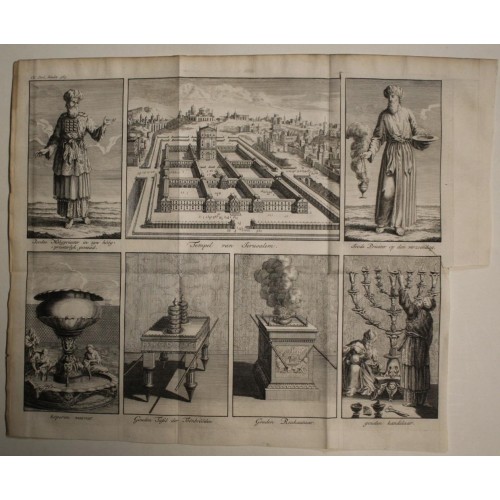
Description: Striking and highly detailed fine unusual copper engraved pate including, on one sheet, a view of the Temple of Jerusalem (at the top centra side), surrounded by five prints depicting the Hight Priest of Israel, a Priest of Israel, the Molten Sea, the Table of the showbread, the Altar of the Burnt Offering and the Menorah.
The Temple in Jerusalem, or alternatively the Holy Temple (Hebrew: бЕМйъОдЗоДМчАгИМщС, Modern: Bēt haMīqdaљ, Tiberian: Bēṯ hamMīqdāљ; Arabic: ИнК ЗбгЮПУ, Bayt al-Maqdis), refers to the two now-destroyed religious structures that served as the central places of worship for Israelites and Jews on the modern-day Temple Mount in the Old City of Jerusalem. According to the Hebrew Bible, the First Temple was built in the 10th century BCE, during the reign of Solomon over the United Kingdom of Israel. It stood until c. 587 BCE, when it was destroyed during the Babylonian siege of Jerusalem. Almost a century later, the First Temple was replaced by the Second Temple, which was built after the Neo-Babylonian Empire was conquered by the Achaemenid Persian Empire. While the Second Temple stood for a longer period of time than the First Temple, it was likewise destroyed during the Roman siege of Jerusalem in 70 CE.
Projects to build the hypothetical "Third Temple" have not come to fruition in the modern era, though the Temple in Jerusalem still features prominently in Judaism. Today, the Temple Mount is the site of the Dome of the Rock and Al-Aqsa Mosque, with the latter having a high level of significance as the third-holiest site in Islam.
The Molten Sea or Brazen Sea (йн оецч yām mūṣāq "cast metal sea") was a large basin in the Temple in Jerusalem made by Solomon for ablution of the priests. It is described in 1 Kings 7:23–26 and 2 Chronicles 4:2–5. It stood in the south-eastern corner of the inner court. According to the Bible it was five cubits high, ten cubits in diameter from brim to brim, and thirty cubits in circumference. The brim was like the rim of a cup or like a lily blossom, and its thickness was a hand breadth", three or four inches. It was placed on the backs of twelve oxen, standing with their faces outward. It was capable of containing two or three thousand baths of water (2 Chronicles 4:5). The fact that it was a wash basin which was too large to enter from above lends to the idea that water would likely have flowed from it down into a subcontainer beneath. The water was originally supplied by the Gibeonites, but was afterwards brought by a conduit from Solomon's Pools. The molten sea was made of brass or bronze, which Solomon had taken from the captured cities of Hadarezer, the king of Zobah (1 Chronicles 18:8). Ahaz later removed this laver from the oxen, and placed it on a stone pavement (2 Kings 16:17). It was destroyed by the Chaldeans (2 Kings 25:13).
The table of showbread was located in the first tabernacle, that is, in the holy place.
The menorah (Hebrew: оАреЙшИд mənōrā, Hebrew pronunciation: [menoˈʁa]) is a seven-branched candelabrum that is described in the Hebrew Bible as having been used in the Tabernacle and in the Temple in Jerusalem. Since antiquity, it has served as a symbol of the Jewish people and Judaism in both the Land of Israel and the Diaspora; it is depicted on the Israeli national emblem.
According to the Hebrew Bible, the menorah was made out of pure gold, and the only source of fuel that was allowed to be used to light the lamps was fresh olive oil. Biblical tradition holds that Solomon's Temple was home to ten menorahs, which were later plundered by the Babylonians; the Second Jewish Temple is also said to have been home to a menorah. Following the Roman besiegement of Jerusalem in 70 CE, the menorah was taken to Rome; the Arch of Titus, which still stands today, famously depicts the menorah being carried away by the triumphant Romans along with other spoils of the destroyed Second Jewish Temple. Traces of the temple menorah have been lost since late antiquity.
Representations of the temple menorah have been discovered on Jewish tombs and monuments dating from the first century. As a symbol, the menorah has been used since then to distinguish synagogues and Jewish cemeteries from the places of worship and cemeteries of Christians and pagans.The Hanukkah menorah, a nine-branched variant, is closely associated with the Jewish festival of Hanukkah.
The plate has been published in: K. Westerbaen. Algemeene Historie Beschreven door een Gezelschap van Geleerde Mannen in Engelandt, uit het engels verstaald, En met aantekeningen enz. vermeerderd ..... Utrecht: Hemanus en Johannes Besseling, MDCCL (1750).
Date: 1750 ( undated )
Dimension: Paper size approx.: cm 38,7 x 30,6
Conditions: Very strong and dark impression on good paper. Paper with chains. Map uncolored. Wide margin to the top. Wide lower margin. Wide right lateral margin partially missing at the lower side. Small left lateral margin. Corners partially missing. Small foxing and browning. Small tears. Sheet folded. Conditions are as you can see in the images.
11571
- Product Code: 11571
- Availability: In Stock
-
$0.00
- Ex Tax: $0.00