
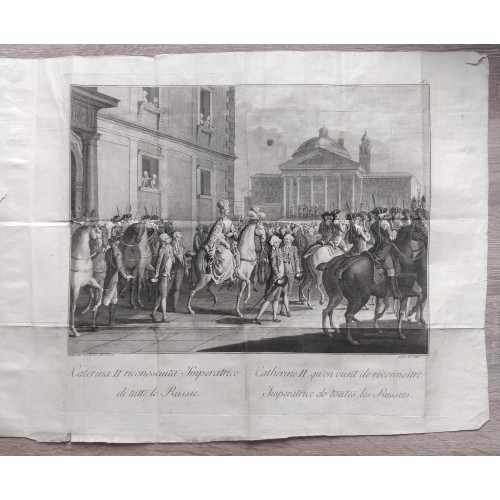
CATHERINE THE GREAT'S CORONATION ST. PETERSBURG RUSSIA 1798 ZATTA ANTIQUE PLATE
ANTIQUE COPPER ENGRAVED PLATE OF CATHERINE THE GREAT
Condition:
--not specified
Ended:Jul 13, 2022 , 7:05AM
Winning bid:
US $261.00
CATHERINE THE GREAT SAINT PETERSBURG RUSSIA 1798 ZATTA ANTIQUE ORIGINAL PLATE
Description
Caterina II , riconosciute Imperatrice di tutte le Russie. // Catherine II, qu'on vient de rйconnoitre Imperatrice de toutes les Russies.
Description: Striking and highly detailed very interesting unusual 1798 Antonio Zatta's copper engraved plate depicting Catherine II riding a white horse surrounded by Russian nobles and soldiers on horseback through the streets of St. Petersburg on the occasion of the Imperial Procession for her Coronation as Tsarina of all the Russias.
Catherine II (born Sophie of Anhalt-Zerbst; 2 May 1729 – 17 November 1796), most commonly known as Catherine the Great, was Empress of Russia from 1762 until 1796, the country's last empress regnant and longest-ruling female leader. She came to power following the overthrow of her husband and second cousin, Peter III. Under her long reign, inspired by the ideas of the Enlightenment, Russia experienced a renaissance of culture and sciences, many new cities, universities and theaters were founded, a large number of European immigrants moved to Russia, and Russia was recognized as one of the great powers of Europe.
In her accession to power and her rule of the empire, Catherine often relied on her noble favourites, most notably Count Grigory Orlov and Grigory Potemkin. Assisted by highly successful generals such as Alexander Suvorov and Pyotr Rumyantsev, and admirals such as Samuel Greig and Fyodor Ushakov, she governed at a time when the Russian Empire was expanding rapidly by conquest and diplomacy. In the south, the Crimean Khanate was crushed following victories over the Bar confederation and Ottoman Empire in the Russo-Turkish War, 1768–1774. With the support of the United Kingdom, Russia colonised the territories of Novorossiya along the coasts of the Black and Azov Seas. In the west, the Polish–Lithuanian Commonwealth, ruled by Catherine's former lover King Stanislaus Augustus Poniatowski, was eventually partitioned, with the Russian Empire gaining the largest share. In the east, Russians became the first Europeans to colonise Alaska, establishing Russian America.
Catherine reformed the administration of Russian guberniyas (governorates), and many new cities and towns were founded on her orders, most notably Odessa, Dnipro, Kherson, Mykolaiv and Sevastopol. An admirer of Peter the Great, Catherine continued to modernise Russia along Western European lines. However, military conscription and the economy continued to depend on serfdom, and the increasing demands of the state and of private landowners intensified the exploitation of serf labour. This was one of the chief reasons behind rebellions, including the large-scale Pugachev Rebellion of Cossacks, nomads, peoples of Volga and peasants.
The period of Catherine the Great's rule is also known as the Catherinian Era. The Manifesto on Freedom of the Nobility, issued during the short reign of Peter III and confirmed by Catherine, freed Russian nobles from compulsory military or state service. Construction of many mansions of the nobility, in the classical style endorsed by the empress, changed the face of the country. She is often included in the ranks of the enlightened despots. As a patron of the arts, she presided over the age of the Russian Enlightenment, including the establishment of the Smolny Institute of Noble Maidens, the first state-financed higher education institution for women in Europe.
The plate has been drawn by Pietro Antonio Novelli, engraved by Giannantonio Zuliani and published by Antonio Zatta.
Date: 1798 ( undated )
Dimension: Paper size approx.: cm 51,6 x 40,9
Condition: Very strong and dark impression on good paper. Paper with chains and wiremarks. Map uncolored. Wide margins. Corners partially missing. Small foxing and browning. Small marginal tears. Small stains. Map folded. Conditions are as you can see in the images.
Cartographer: Antonio Zatta (1775-1797) was the most prominent Italian map publisher of the late 18th and early 19th century. His firm, based in Venice, produced maps that mark an important transition from 18th to 19th century cartographic styles. He updates and redefines the traditional title cartouche by replacing the mythic elements common to the 17th and 18th century with more representative images. He maps also strive to keep many 18th century details, such as figural depictions on the map itself, while striving for the accuracy that a 19th century clientele demanded. His most important work is the four volume Atlante novissim published from 1775 to 1789.
Pietro Antonio Novelli (1729–1804) was an Italian painter and engraver. Novelli trained with the Venetian painter Jacopo Amigoni. In 1768, he was accepted as a member of the Accademia di Belle Arti in Venice. Novelli produced altarpieces and frescoes throughout northern Italy. Some of his commissions came from Catherine the Great. He moved to Rome around 1779 where he remained for over 20 years. He later returned to Venice where he died in 1804. His memoirs were published posthumously in 1834.
Giannantonio Zuliani was a Venetian engraver active during the 18th century. He was born in Venice in 1760, died in Venice in 1836 at the age of 76.
10923
- Product Code: 10923
- Availability: In Stock
-
$0.00
- Ex Tax: $0.00