
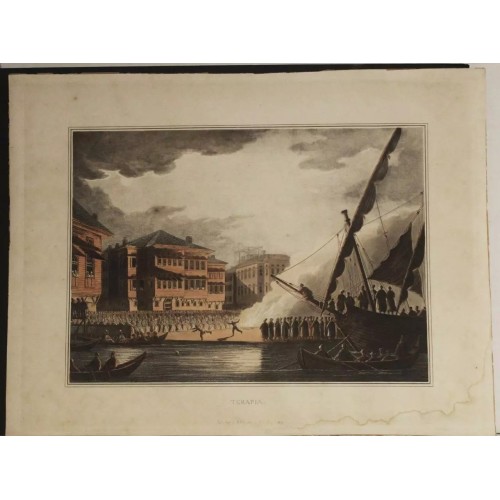
TARABYA TURKEY 1809 LUIGI MAYER UNUSUAL ANTIQUE COPPER ENGRAVED CITY VIEW
ANTIQUE COPPER ENGRAVED CITY VIEW OF TARABYA TURKEY
old times rare books and maps
(20333)
100% positiveSeller's other itemsSeller's other itemsContact seller
US $24.50
TARABYA TURKEY 1809 LUIGI MAYER UNUSUAL ANTIQUE COPPER ENGRAVED CITY VIEW
Description
Terapia.
Description: Striking and highly detailed fine unusual 1809 Luigi Mayer's copper engraved (aquatint) plate showing a feast at Tarabya, on the northwestern coast of the Bosporus. Several inhabitants and sailing ships adorn the view.
Tarabya (Ottoman Turkish: Tarabiye, Greek: Te?ape??, romanized: Therapiб) is a neighbourhood in the municipality and district of Sariyer, Istanbul Province, Turkey. It is located on the European shoreline of the Bosphorus strait, between the neighbourhoods of Yenikцy and Kireзburnu.
The area used to be called Pharmakia. This name is believed to have been given here by Medea, the names means "poison" in Ancient Greek. According to tradition, Attikos, an Orthodox patriarch was uncomfortable with the name being related to poison, so changed it to "Therapia". Therapia was conquered by the Ottomans in 1453. Then a minor Byzantine castle, it fell during the first few days of the Fall of Constantinople, and 40 Roman soldiers were executed.
It was noted as a Greek village in the 17th century, but around a hundred years a few Armenians and Muslims also lived there. Over time, it became a tiny fishing village inhabited almost completely by Orthodox Christians. The village became the centre of the Terkos Metropolis in 1655,which transformed the village. Thanks to its new religious position and relative proximity to Constantinople, it became one of the most important settlements on the European side of the Bosphorus. Due to its great climate and safety from diseases such as Cholera, many members of the Greek aristocracy moved their place of residence here. Many foreign embassies and merchants also started to move here, and became the favourite place of the ruling Greek elite. Some Greek families kept their property here until the Greek war of Independence in 1821, after which they were confiscated. The town remained mostly Greek until around the middle of the 20th century. During the Istanbul pogrom, a church built in 1796 and the metropolitan residence was put to fire. During the following years, due to the worsening Turkish-Greek relations and the invasion of Cyprus, most Greeks were forced to move out. The Greek school was closed down in 1985. Around this time, around 50 Greeks -mostly elderly- lived in Tarabya.
Source: MAYER, Luigi. Views in the Ottoman Dominions, in Europe in Asia, and some of the Mediterranean Islands, from the Original Drawings taken for Sir Robert Ainslie by Luigi Mayer, F.A.S. with descriptions historical and illustrative, London, P. Bowyee, 1810.
Date: 1809 ( dated )
Dimension: Paper size approx.: cm 42,5 x 32,1
Condition: Very strong and dark impression on good paper. Sheet old original colored. Small foxing and browning. Small waterstains. Conditions are as you can see in the images.
Mapmaker: Luigi Mayer (1755-1803) was a painter of German and Italian descent. He was born in Rome, was a pupil of well-known engraver J.B. Piranesi and worked for Ferdinand, King of Naples, creating paintings of the antiquities of Sicily. Later on, probably from 1776, he was in Istanbul and formed part of the circle of Sir. R. Ainslie, ambassador of Britain to the Sublime Gate (1776-1792). From then onwards, the ambassador financed Mayer's journeys so that the artist would draw and depict sights in the Ottoman empire and in particular the antiquities.
By the information provided in an anonymous account in manuscript, by a person who travelled with the artist for some time, and the subjects of Mayer's paintings, it is possible to recompose his itinerary, at least for the year 1792. Mayer travelled and made drawings of landscapes in Cyprus, Egypt, Palestine, Syria, Caramania, Rhodes, Caria, Lycia and Samos. Some of his works from Ephesus and Corinth are known, but it is unclear when he visited those locations. Finaly, while accompanying Ainslie on his return trip to England, Mayer was able to paint landscapes in European Turkey, Bulgaria and Rumania.
Mayer did not limit himself to drawing ancient monuments, but also added picturesque details from everyday life, local costume and expressions of social life. It is unknown where the original drawings by the artist are today. A number of his works formed part of the Ainslie Collection and were later given to the British Museum.
Mayer's works became very popular, were lithographed and circulated widely in consecutive editions from 1801 onwards. These editions, which were completed gradually, included paintings by Mayer representing various subjects and done in various engraving techniques, coupled with commentaries in three languages.
12243
- Product Code: 12243
- Availability: In Stock
-
$0.00
- Ex Tax: $0.00