
Юкмага верже
22-37
16-10 размер каждого изобажения
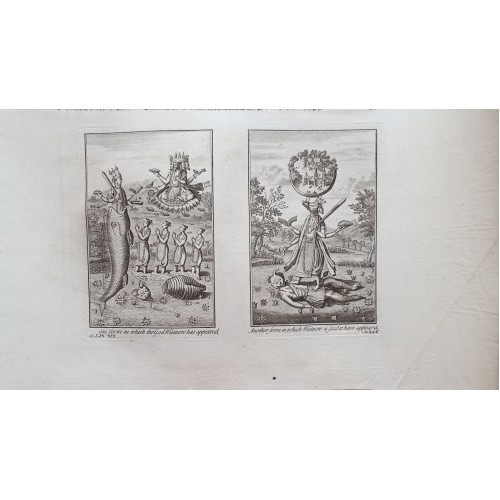
Description: Antique print titled 'Premiere Incarnation (..)'. Old print of the first four incarnations (avatars) of the Hindu god Vishnu. According to the Bhagavad Gita, each of Vishnu’s ten avatars saved the world. The first avatar was a fish that lifted the vedas from the ocean. The second was a turtle that carried the world on its back to ensure its stability. The third was a boar that rescued the Earth, which had been thrown into the ocean by demons. The fourth was a half-lion, half-human creature that tore the demon Hiranyakashapu to pieces. Originates from 'Ceremonies et coutumes Religieuses...' , by A. Moubach.
Artists and Engravers: Bernard Picarts was a French painter and engraver.
Condition: Very good, please study image carefully.
Premiere Incarnation - Matsya Avatar Year: 1723 to 1737 The early contacts between Europe and India were largely a result of voyages made for trading purposes. Many Europeans developed a keen interest and maintained journals, keeping accounts of their discoveries and travels in India. Some of these works and illustrations culminated into varied forms of prints. Some of these manifestations were fanciful, for many of these print-makers had never visited India. Nevertheless, they offer a rich store of information of the early days and the stylistic traditions prevailing in India and European countries. Bernard Picart was one of the most prolific engravers of his time in 18th Century Europe. Between 1723 to 1737, Picart in collaboration with publisher Jean Frederic Bernard, published their ambitious 7 volume magnum opus “Ceremonies et Coustumes Religieuses de tous les Peuples du Monde”, which translated simply means ‘Ceremonies and Religious Customs of all the people of the world’. Premiere Incarnation – Matsya Avatar, one of the ten avataras of Lord Vishnu, is an engraved plate from the set. Picart who was a masterful engraver, never visited India but for his works he largely relied on the sources available to him to present the European view of India, a testimony to prove the attention the engraver paid to the minutest of details.
The First to Fourth Incarnations of the Hindu God Vishnu
Bernard Picart - engraver
Антикварная гравюра «'Premiere Incarnation» изображает первое и третье воплощения (аватары) индуистского бога Вишну.
Согласно Бхагавадгите, каждый из десяти аватаров Вишну спас мир.
Первым аватаром была рыба, поднявшая Веды из океана (левый рисунок)
Второй была черепаха, которая несла мир на своей спине, чтобы обеспечить его устойчивость. Третьим был вепрь, спасший Землю, брошенную демонами в океан. (правый рисунок)
Четвертым было существо полулев-получеловек, которое разорвало демона Хираньякашапу на куски.
Лист из книги "Ceremonies et Coustumes Religieuses de tous les Peuples du Monde" , by Bernard Picart
Художник и гравер: Берна́р Пикар (Bernard Picart) французский рисовальщик, живописец и гравёр, мастер офорта и меццо-тинто; выдающийся мастер книжной иллюстрации конца XVII — начала XVIII века. Значительную часть жизни проработал в Нидерландах.
Первые контакты между Европой и Индией были в основном результатом путешествий, совершавшихся в торговых целях. Многие европейцы проявили живой интерес и вели журналы, в которых вели отчеты о своих открытиях и путешествиях по Индии. Некоторые из этих работ и иллюстраций воплотились в гравюры различных форм. Некоторые из этих проявлений были причудливыми, поскольку многие из этих гравёров никогда не бывали в Индии. Тем не менее, они предлагают богатый запас информации о первых днях и стилистических традициях, преобладающих в Индии и европейских странах. Бернар Пикар был одним из самых плодовитых граверов своего времени в Европе XVIII века. Между 1723 и 1737 годами Пикар в сотрудничестве с издателем Жаном Фредериком Бернаром опубликовал свой амбициозный семитомный выдающийся опус «Ceremonies et Coustumes Religieuses de tous les Peuples du Monde», что в переводе просто означает «Церемонии и религиозные обычаи всех народов мира». '.
Пикар, который был искусным гравером, никогда не посещал Индию, но в своих работах он в основном полагался на доступные ему источники, чтобы представить европейский взгляд на Индию, что является свидетельством того внимания, которое гравер уделял мельчайшим деталям.
Размер листа - 22-37 см, размер каждого изображения: 16-10 см
Состояние - см фото
11637
- Product Code: 11637
- Availability: In Stock
-
$0.00
- Ex Tax: $0.00