
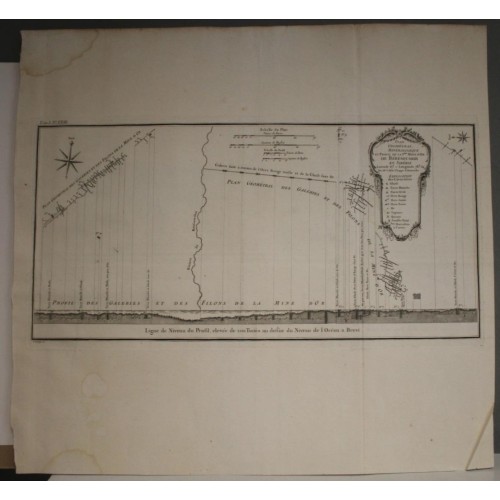
BERYOZOVSK GOLD MINES RUSSIA 1768 CHAPPE D'AUTEROCHE ANTIQUE GEOLOGICAL MAP
ANTIQUE COPPER ENGRAVED GEOLOGICAL MAP BEREZOVSK MINES
BERYOZOVSK GOLD MINES RUSSIA 1768 CHAPPE D'AUTEROCHE ANTIQUE GEOLOGICAL MAP
Description
Plan Gйomйtral, Minйralogique et profil de la I.ere Mine d'Or de Bйrйsouskoi en Sibйrie.
Description: Striking and highly detailed fine unusual 1768 copper engraved geological map including a profile and a plan of the Beryozoskoye Deposit, Russia.
Beryozovskoye deposit, Berezovskoe gold deposit, Berezovsky deposit, Berezovsk Mines, and some other names (Russian: Берёзовское месторождение) is the first known primary deposit of gold in Russia. It is located 13 km northwest of Yekaterinburg in the central Urals Federal District. It was discovered in 1745 by a raskolnik Yerofey Markov. The first mine was established in 1747. The deposit is named after the Beryozovka River (a tributary of Pyshma River) and is associated with the settlement of Berezovsky, now the town of Beryozovsky, Sverdlovsk Oblast.
The following minerals were discovered at the deposit: aikinite (1789), vauquelinite (1819), cassedanneite (1988), crocoite (1766), pyrophyllite (1829), phenicochroite (1839), embreyite (1972).
The discovery of crocoite by Johann Gottlob Lehmann in 1766 at the Berezovsk Mines was the starting point of the discovery of the element chromium. Berezovsk Mines were for a long time the only source for crocoite and therefore the only source of the pigment chrome yellow.
Publication History
The map was published to accompany Auteroche's narrative of his expedition to Tobolsk to observe the 1761 Transit of Venus, Rйcit du voyage que Chappe d'Auteroche effectua en Sibйrie de novembre 1760 а aoыt 1762. The cartography is primarily derived from the 1731 – 1742 surveys of Stepan Petroviи Kraљeninnikov, completed during Vitus Bering's Great Northern Expedition (1731 – 1742). It was engraved by Goisey. This is one of the finest obtainable early maps of Kamchatka.
Source: Jean-Baptiste Chappe d'AuterocheRйcit du voyage que Chappe d'Auteroche effectua en Sibйrie de novembre 1760 а aoыt 1762, (Paris: Debure) 1768.
Date: 1768 ( undated )
Dimension: Paper size approx.: cm 52,9 x 49,8
Condition: Very strong and dark impression on strong paper. Paper with chains and wiremark. Map uncolored. Wide margins. Small foxing. Small browning. Small waterstains. Map folded. Conditions are as you can see in the images.
Mapmaker: Jean-Baptiste Chappe d'Auteroche (March 23, 1722 – August 1, 1769) was a French astronomer and explorer. He was born to a noble family of Auvergne, France. He entered the priesthood where is was able to dedicated himself to the study of Astronomy. he was appointed assistant Astronomer at the Royal Observatory and, on January 14, 1758, was admitted to the Paris Acadйmie des Sciences. Auteroche is best known for his observation of the Transit of Venus in 1761 and in 1769. The scientific world at the time recognized an unprecedented opportunity to determine the size of the Solar System using exact observations of the Transits of Venus in 1761 and again in 1769. By applying the calculations associated with these transits in the light of Kepler's Laws of Planetary Motion, it was possible to determine for the first time the distance between planets. Auteroche's first expedition led him to Siberia, where is observed the 1761 transit from Tobolsk. He observed the second transit, in 1769, from Baja California in Mexico. On the return voyage the crew of Auteroche's ship were struck by Yellow Fever. With the exceptional of a single passenger, everyone on board, including Auteroche, died. That survivor managed to salvage Auteroche's notes and return them to the Acadйmie des Sciences in Paris. Auteroche's notes and journals were published posthumously by Cesar Cassini de Thury.
10285
- Product Code: 10285
- Availability: In Stock
-
$0.00
- Ex Tax: $0.00