
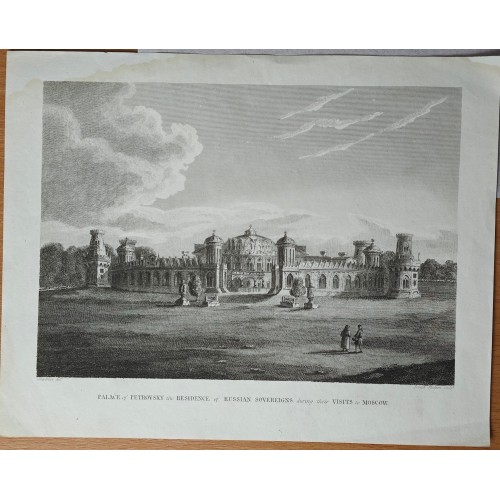
? Антикварная гравюра "Петровский дворец, резиденция русских государей во время их посещений Москвы", 1810
? Оригинальное название "Palace of Petrovsky the Residence of Russian Sovereigns during their Visits to Moscow"
?Pазмер листа 23.5х19 см
Pазмер изображения 14.5х20 см
?Лист с видом Петровского дворца под Москвой, выполненный как отдельная гравюра (оттиск) по рисунку Эдварда Дэниела Кларка около 1810 г., изданная в Лондоне; изображает протяжённый фасад дворца и фигуры гуляющих людей на переднем плане
? Рисунок принадлежит английскому путешественнику и художнику Эдварду Дэниелу Кларку (Edward Daniel Clarke, 1769–1822).
Гравюра отпечатана в Лондоне, в англоязычных каталогах лист упомянут просто как “engraving published in London c.1810” без упоминания конкретного издателя.
?Бумага и изображение в отличном состоянии, на обратной стороне текст - не просвечивает
7062
PETROVSKY PALACE MOSCOW RUSSIA 1810 CLARKE ANTIQUE ORIGINAL COPPER ENGRAVED VIEW
ANTIQUE ORIGINAL VIEW OF PETROVSKY PALACE MOSCOW
Condition:
--not specified
Ended:
Oct 18, 2023 22:01:32 PDT
Winning bid:
US $19.50
PETROVSKY PALACE MOSCOW RUSSIA 1810 CLARKE ANTIQUE ORIGINAL COPPER ENGRAVED VIEW
Description
Palace of petrovsky the Residence of Russian Sovereigns during their Visits to Moscow.
Description: Striking and highly detailed fine unusual copper engraved view of the Petrovsky Palace, the residence of russian sovereigns in Moscow, Russia. The palace remained as a royal residence until 1918. The view shows the Palace, gardens and surrounding landscape. Several inhabitants adorn the view.
Date: 1810 ( undated )
Dimension: View size approx.: cm 20,2 x 14,4 === Paper size approx.: cm 23,3 x 18,9
Condition: Very strong and dark impression on good paper. Map uncolored. Wide margins. Small foxing and browning. Conditions are as you can see in the images.
Author: Edward Daniel Clarke (5 June 1769 – 9 March 1822) was an English clergyman, naturalist, mineralogist, and traveller.
Edward Daniel Clarke was born at Willingdon, Sussex, and educated first at Uckfield School[1] and then at Tonbridge.
In 1786 he obtained the office of chapel clerk at Jesus College, Cambridge, but the loss of his father at this time involved him in difficulties. In 1790 he took his degree, and soon after became private tutor to Henry Tufton, nephew of the Duke of Dorset. In 1792 he obtained an engagement to travel with Lord Berwick through Germany, Switzerland and Italy. After crossing the Alps, and visiting a few of the principal cities of Italy, including Rome, he went to Naples, where he remained nearly two years. While in Naples, Clarke climbed Vesuvius on numerous occasions, to take guests to the summit and observe the state of activity of the volcano. He also constructed a model of Vesuvius, which Sir William Hamilton declared to be the 'best ever produced'. This model was later transported to Lord Berwick's seat at Attingham Park.
Having returned to England in the summer of 1794, he became a tutor to several distinguished families. In 1799 he set out with John Marten Cripps on a tour through the continent of Europe, beginning with Norway and Sweden, whence they proceeded through Russia and the Crimea to Constantinople, Rhodes, and afterwards to Egypt and Palestine. After the capitulation of Alexandria, Clarke helped to secure for England a number of statues, sarcophagi, maps, manuscripts and other antiquities which had been collected by French savants in the city.
Greece was the next country they visited. From Athens, the travellers proceeded by land to Constantinople, and after a short stay in that city directed their course homewards through Rumelia, Austria, Germany and France. Clarke, who had now obtained considerable reputation, took up his residence at Cambridge. He received the degree of LL.D. shortly after his return in 1803, on account of the valuable donations, including a colossal statue of the Eleusinian Ceres, which he had made to the university.
He was also presented to the college living of Harlton, near Cambridge, in 1805. Four years later, his father-in-law added that of Yeldham. Towards the end of 1808 Dr Clarke was appointed to the newly created Professorship of mineralogy in Cambridge. His perseverance as a traveller and collector was also rewarded financially: the manuscripts which he had collected in the course of his travels, among them the celebrated Clarke Codex of Plato's dialogues (895 CE), were sold to the Bodleian Library for Ј1000; and by the publication of his travels he realized altogether a clear profit of Ј6595.
Besides lecturing on mineralogy and discharging his clerical duties, made several discoveries in chemistry, principally by means of the gas blow-pipe, which he had brought to a high degree of perfection. He was also appointed university librarian in 1817, and was one of the founders of the Cambridge Philosophical Society in
7062
- Product Code: 7062
- Availability: In Stock
-
$0.00
- Ex Tax: $0.00