
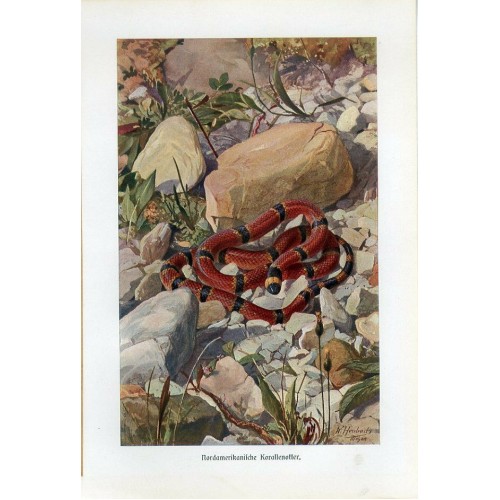
Антикварная немецкая Литография Коралловые змеи 1900
Отпечатана в Bibliographisches Institut в Лейпциге, Германия
Общий размер с полями примерно 31 см x 24 см. Обратная сторона чистая
Прекрасная печать
Библиографический институт (Bibliographisches Institut ) - крупный немецкий издательский дом, основанный Джозефом Мейером в 1826 г. Издательство принадлежало Джозефу Мейеру (Joseph Meyer, 1796-1856) и его сыну Герману Дж. Мейеру (Herrmann J. Meyer 1826-1909). Издательство Мейера прославилось иллюстрированными сериями «Универсум Мейера» и «Энциклопедический лексикон Мейера».
Литография яркая, с красивыми и чистыми картинками, в хорошем состоянии, несмотря на возраст.
Это подлинная иллюстрация 20 века, которую можно вставить в раму и украсить ими ваш интерьер. Со временем цена на гравюры и литографии только растет. Приобретение антикварных предметов является прекрасной инвестицией и поможет сберечь и приумножить ваши деньги.
Состояние можно увидеть на фото - сканер не показывает всю красоту картинки и может искажать цвет.
Отлично смотрится в рамке с паспарту.
Оформленнaя гравюра или литография - пpeвосxоднoe укрaшение для интерьepа, онa прeкрaсно впишетcя в любoй cтиль oформления. Cочетание очарования сюжета, антикварной редкости и уникальности гравюры с демократичной ценой, позволит преобразить Ваш интерьер. Гравюры и литографии - перспективный предмет для коллекционирования, которые практически не подделывают, а их репродукции легко распознать. Коллекционирование гравюр и литографий - увлечение, доступное практически любому и не требующее глубокого профессионального изучения предмета.
#7707
-----
✨ Antique Chromolithography Prints North Amecican Coral Snake Reptile print Herpetology snake , 1900
✨ This is authentic antique (not a modern reproduction) beautiful print comes from a German "Tierleben" by A.Brehm. Printed by Bibliographisches Institut Leipzig,Germany,during circa 1900.
? Alfred Edmund Brehm (1829-1884), was a German zoologist, natural history illustrator and writer, the son of Christian Ludwig Brehm. Through the book titled 'Brehms Tierleben', his name became a synonym for popular zoological literature. Litho by or after W. Heubach.
? Artist W.Heubach
? The print is a beautifully detailed engraving, printed on medium-weight, creamy coloured paper, blank on the reverse. This print would look lovely if mounted and framed, either on its own, or in association with one of our other bird illustrations.
? 9 1/2" x 6 1/4" (16 cm x 2cm) (sheet size)
8 1/2" x 12" (21 cm x 30 cm) (mat size)
Blank of Reverse.
Printed on the smooth paper.
? Coral snakes are highly venomous members of the Elapidae family. They’re split into Old World and New World groups, most of which inhabit sparsely populated areas. They’re generally small snakes, between 2 and 4 feet; the Arizona coral snake is sometimes thinner than a pencil.
The Old World groups live in Asia, India, and the islands of Southeast Asia. These snakes are classified into three genera with about 20 species. They exhibit the widest variation in color patterns, from mostly blackish-blue with orange on their head and tail.
The New World coral snakes live in the Americas, in the southern United States, throughout Central and South America. Many of them have red, yellow, and black patterns but not all. Of all the coral snake species, the Americas are home to by far the largest variety. There are dozens of species, approaching 80; however, with all that variety they are only classified into two genera.
Amazing Facts About Coral Snakes
Coral snakes are highly venomous, second behind black mambas, but their venom delivery system is lacking; their fangs are small and weak, and not hollow like a pit viper’s fangs.
In North America, they’re the only venomous snakes to lay eggs. The others are all pit vipers that give birth.
Many coral snakes spend their time buried in leaf litter or otherwise hiding; they wait for their prey to come to them.
A few species are aquatic; their tails are flattened and act as a paddle.
Where to Find Coral Snakes
Coral snakes inhabit the Americas, like in Alabama, and many areas of India, Asia, and the islands of Southeast Asia. These snakes vary widely in behavior, but are mostly fossorial, digging into leaf litter and hiding in abandoned burrows. Many do not come out except to breed or during the rainy season. A few are mostly aquatic and spend most of their time in the water with dense vegetation.
They mainly eat rodents, but will also eat salamanders, frogs, lizards, birds, and occasionally other snakes. Some species, like the blue Malaysian coral snake, eats primarily snakes.
Coral Snakes: Population and Conservation
Coral snakes don’t breed very quickly - many only lay 2 or 3 eggs at a time. Some coral snakes are considered endangered in part of their habitat; for example, North Carolina considers the eastern coral snake (M. fulvius) endangered. The IUCN Redlist has several listed as vulnerable with decreasing populations; including the Roatan coral snake (M. ruatanus), the Oaxacan coral snake (M. ephippifer), and the Japanese coral snake (S. japonicus).
Identifying Coral Snakes: Appearance & Description
The rhyme many school kids learned works most of the time for the eastern and Texas coral snakes; it sort of works with the Arizona species which often has white bands instead of yellow. It’s not completely reliable, however, and the further you go from the United States, the less it works. Add to that, several snake species mimic coral snake colors, such as the king snakes and milk snakes that have similar banding.
So, learning to identify the coral snakes that live in your area is the best way to go.
Snakes such as the eastern, Texas, and Arizona coral snakes do have a couple of things in common: They have blunt heads and tails, and their color pattern extends all the way around their bodies. The non-venomous look-alikes’ color stops at their bellies.
The rhyme doesn’t work at all with Asian species; their colors and patterns vary greatly from species to species.
Venom: How Dangerous are Coral Snakes
Despite their highly toxic venom and fearsome reputation, North American coral snakes are considered less dangerous than rattlesnakes and copperheads. Their venom is the second most toxic in the world after black mambas and is composed of neurotoxins that attack the respiratory system. A severe bite can cause death in just a few hours, which makes immediate medical care vital.
Toxicity of their venom aside, these snakes have a poor venom delivery system. Unlike vipers, coral snakes don’t have hollow fangs attached to a venom gland. Their fangs have a groove that the venom travels down when they bite; rather than striking and releasing, coral snakes have to chew on their prey to get venom injected.
Coral Snake Behavior and Humans
Coral snakes are highly venomous, but surprisingly few bites occur every year. Unlike the mambas and cobras, their less reclusive cousins, they are excellent escape-artists and often leave before you ever have a chance to see them. If you do see one, your best bet is to back away and give it space to leave; they’re not generally aggressive and will not chase you.
They’re reclusive and spend much of their time buried in leaf litter, underground, or otherwise hidden on the rainforest floor. Over 90% of the bites incurred happen after someone picks up one of these snakes.
As with other dangerous animals, only those with proper training and experience should handle them.
♥ Great antique print for framing!
? Your purchase is this original plate; I do not deal in modern reprints, reproductions or copies.
? The paper is in very good condition and the drawings look stunning. Please look at the photos carefully, including cropped detail photos, which will show you more than you can see with your eyes alone.
? Pictures are part of the description and reflect the current state of the article. The real color of the item may be slightly different from the pictures shown on website caused by many factors such as brightness of your monitor and light brightness.
? Shipping: Standard domestic and international shipping. We are more than happy to combine purchases.
We ship via registered airmail with the tracking number within 72 hours of receipt of cleared payment.
? Please keep in mind that shipping takes 3-5 weeks to the USA and 10-20 days to Europe.
? Returns: If you are not happy with your item, please return it to us in its original packaging within 14 days. Return shipping must be paid for by the buyer. Refund of purchase price will be made through Paypal.
7707
7707
- Product Code: 7707
- Availability: In Stock
-
$700.00
- Ex Tax: $700.00